Here is how you can replicate the returns and performance of NIFTY LargeMidcap 250 Index using Nifty 50 and Nifty next 50 Index funds. Motilal Oswal had filed an NFO application based on this index with SEBI, but this is unlikely to see the light of day (and that is good for investors). This post is based on a request made on Youtube. Let us start with the basics.
What is the NIFTY LargeMidcap 250 Index? This is a 250 stock index based on 50% of Nifty 100 (large cap index) and 50% Nifty Midcap 150 (midcap index) reset on a quarterly basis.
Why should I take this fund seriously? The active equity mutual fund performance report May 2019 was published just a few days ago. A relevant section is reproduced below. Take multicap funds as an example. There are 42 of them, and if we apply >= 70% return outperformance consistency filter for 5 years, we only have 15 and if we apply the >= 70% downside protection consistency, we left with 14. This is shown below as 42-> 15-> 14. Notice how in all categories listed below, it is pretty hard to beat the Nifty LargeMidcap250 TRI.
Category
Benchmark
Filter
Multicap
Nifty Largemidcap 250 TRI
42 -> 15 -> 14
ELSS
Nifty Largemidcap 250 TRI
31 -> 9 -> 8
Large & Mid cap
Nifty Largemidcap 250 TRI
20 -> 8 -> 8
Value-oriented
Nifty Largemidcap 250 TRI
14 -> 7 -> 6
In fact, we also saw, Aditya Birla Sun Life Tax Relief 96 Fund one of the most consistent ELSS performers has a risk and reward profile close to the Nifty LargeMidcap 250. Hence this index is a good choice to consider for young earners and those who prefer index investing.
🔥Secure your future with our Robo-advisory tool trusted by over 3,500 investors and advisors. From effortless retirement planning to funding your children’s biggest dreams, turn your financial goals into reality. 🔥
Even if there was an ETF or index fund tracking the Nifty Largemidcap 250, it would be better to try and replicate its performance with NIfty 50 and Nifty Next 50 index funds. Why? A 250 index would be tough to manage as even “large cap” stocks are not liquid enough!. So a 250 index fund could have tracking errors especially if the AUM is not high enough (why AUM is important: These five index funds beat their indices! Why you should avoid them!)
So with Nifty 50 and NIfty Next 50 Index funds, the investor has a lot more flexibility in trying to replicate the N250 index. Even if they do not wish to replicate, it can be used as a benchmark for an NN50 + N50 portfolio (with more of NN50).
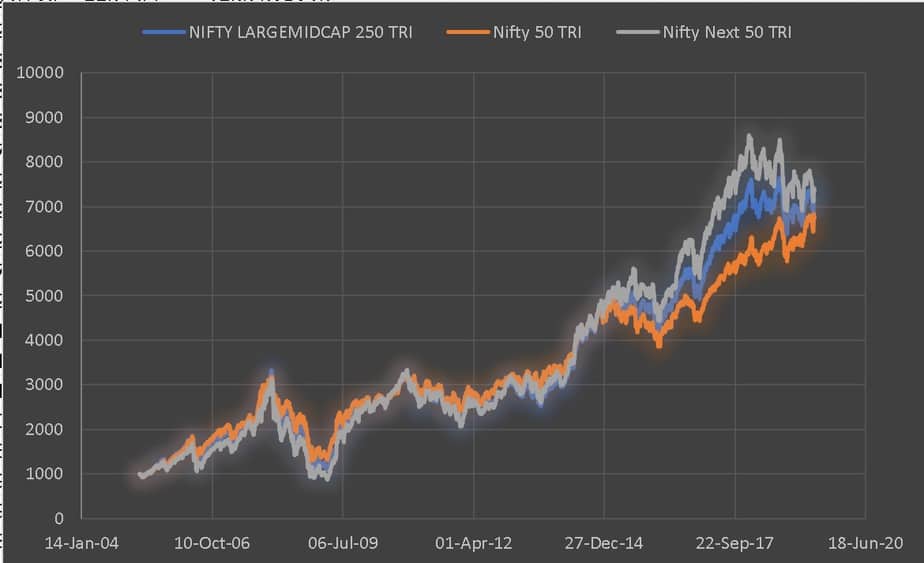
Check what combination of Nifty 50 and Nifty Next 50 monthly returns closely match Nifty LargeMidcap 250 Index monthly returns.
Change Nifty 50 exposure until the difference between the two sets of returns is minimized.
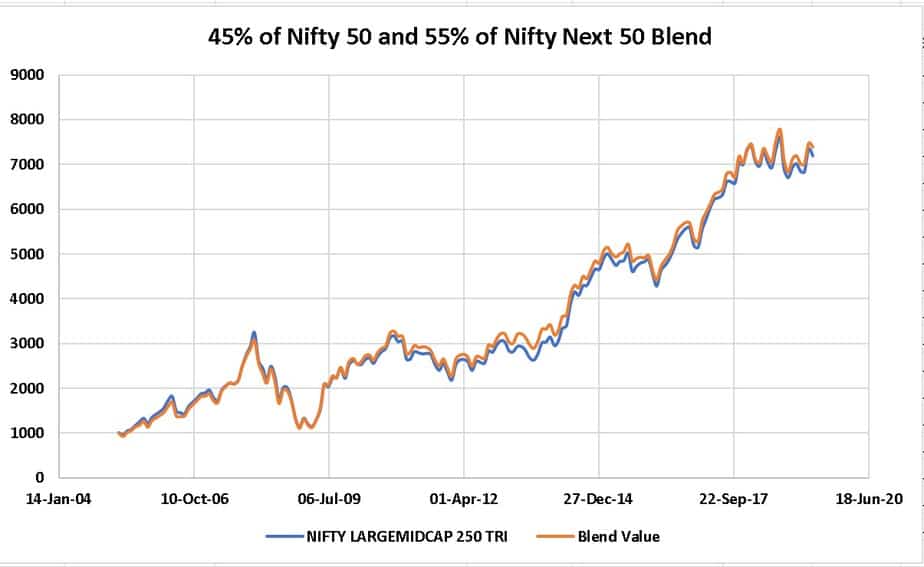
A mix of 45% Nifty 50 TRI and 55% Nifty Next 50 TRI was able to reasonably match the monthly movement of NIfty LargeMIdcap 250 TRI. However, it is important to keep in mind that this approximate and based on a monthly reset (the index itself has a quarterly reset) and of course based on past data. There are 170 data points in the above graph (each line)
A more practical method would be to rebalance only once a year. This results in a mix of 58% Nifty 50 and 42% Nifty Next 50 for the lowest return difference. However, this can be rounded off to 60% Nifty 50, which I like in terms of lower risk.
Note that there only 15 data points in this graph ( each line). While a more thorough study would use every possible 1Y return on a rolling basis, I think intuitively and psychologically 60% of Nifty 50 is appealing.
In summary, a mix of 60% Nifty 50 and 40% Nifty Next 50 Indices with annual rebalancing can be used by investors to replicate the performance of Nifty LargeMidcap 250 index. Which index fund s should I use? Check out previous posts