In this edition of the reader story, 37-year-old Siva shares his financial journey from scratch in 2014 to a net worth of 18 times annual expenses.
About this series: I am grateful to readers for sharing intimate details about their financial lives for the benefit of readers. Some of the previous editions are linked at the bottom of this article. You can also access the full reader story archive.
Opinions published in reader stories need not represent the views of freefincal or its editors. We must appreciate multiple solutions to the money management puzzle and empathise with diverse views. Articles are typically not checked for grammar unless necessary to convey the right meaning to preserve the tone and emotions of the writers.
If you would like to contribute to the DIY community in this manner, send your audits to freefincal AT Gmail dot com. They can be published anonymously if you so desire.
Please note: We welcome such articles from young earners who have just started investing. See, for example, this piece by a 29-year-old: How I track financial goals without worrying about returns. We have also started a new “mutual fund success stories” series. This is the first edition: How mutual funds helped me reach financial independence. Now over to Siva.
🔥Secure your future with our Robo-advisory tool trusted by over 3,500 investors and advisors. From effortless retirement planning to funding your children’s biggest dreams, turn your financial goals into reality. 🔥
Subscribe for money management solutions via email! (Link takes you to our email sign-up form) Join 32,000+ readers in our community.
👉 New Tool Alert! NaviPlan: A Privacy-Focused Multi-asset Tracker and Goal Planner 👈
Like many other readers, I am thankful to Professor Dr Pattabiraman for running this website and helping many retail investors with a treasure trove of information they can learn in their pursuit of financial planning and their financial independence journey.
I chanced upon the website in late 2020. It has been a fascinating journey going through articles, backtests, and perspectives and revisiting a few of them repeatedly to seek inspiration.
Here is my journey and what I plan to do going forward. I am a 37-year-old, and my working career started in 2007. The first decade mostly had its share of start-stops with me pursuing a post-graduation after the initial couple of years for which I had to empty the kitty I was filling with whatever little I could save (including PF + Leave encashment from those few years of work).
After my PG, I landed a decent-paying job and was a diligent saver. I was not reckless even though I lacked nuanced knowledge of investments (did not have optimal investment strategies in place – had a sweeping savings account which was giving FD-like returns, and almost all of my savings went there except for some investments into PPF and a LIC policy (I was enrolled to it by default by my father back in 2008 for … you guessed it right – 80 c benefit;
Recently, calculated the XIRR on this 12-year policy, and it comes to around 5%; Sad story, but that was part of the learning experience). Coming back to my journey, after two years post PG, got married and had to spend whatever I had saved till then to account for expenses on the wedding and on security deposit & furnishing for the rental house, I moved into.
Even as my career began in 2007, I hit a few resets and had to start from zero in mid-2014. Again, saving into my sweeping account continued with some diligent VPF+PPF contributions. There were company stocks I could purchase at a discount for a couple of years starting in 2016 (kicking myself for not starting that off in 2014, but this is all in hindsight, so I pardon myself).
Still, it wasn’t until 2018 that I started looking at Equity as an investment option. I had read about it before, but the paperwork for setting up the KYC to get started was a huge hurdle. Today’s investors might not be aware of the difficulties, especially if you don’t have proper phone address information mapped to proof of identity.
So, those starting today must thank online fintech solutions & Nandan Nilekani for his team’s UID project that allow a lot of this to be done online, not having to go through the layers of friction involved otherwise.
So, equity contributions started in a small way in 2018, but towards the end of 2016, my wife and I saved a decent amount on our sweeping SB Accounts and could go in to purchase our primary residence. I wasn’t much aware of the benefits of renting over buying at that point. Even in hindsight now, I don’t think it’s been a bad decision because we have enjoyed our journey in our home thus far and having moved a few times before, I know how tough it could be to shift across rental places.
We went in with a down payment of 25%, with the rest serviced through an overdraft Home Loan (SBI Maxgain). We felt that would be a good option as we were diligent savers, and we could make the most of it, especially given the limited investment options we knew of at that time.
I should say that decision has worked in our favour as we have been able to accumulate a significant amount of money over these six years into the OD account, so much so that, instead of buying then, if we had decided to go for a house purchase without a loan today, our decision wouldn’t have been much different financially speaking.
What I mean by that is the interest out-go we have had so far only equates to the rent we would have had to pay over these six years, leaving us only with the opportunity cost of interest we could have earned for the five years on the money accumulated (we got to save a bit on taxes the first few years so that that difference wouldn’t be too much). Here is a chart that maps the Interest to Principal outgo on our EMIs for this journey.
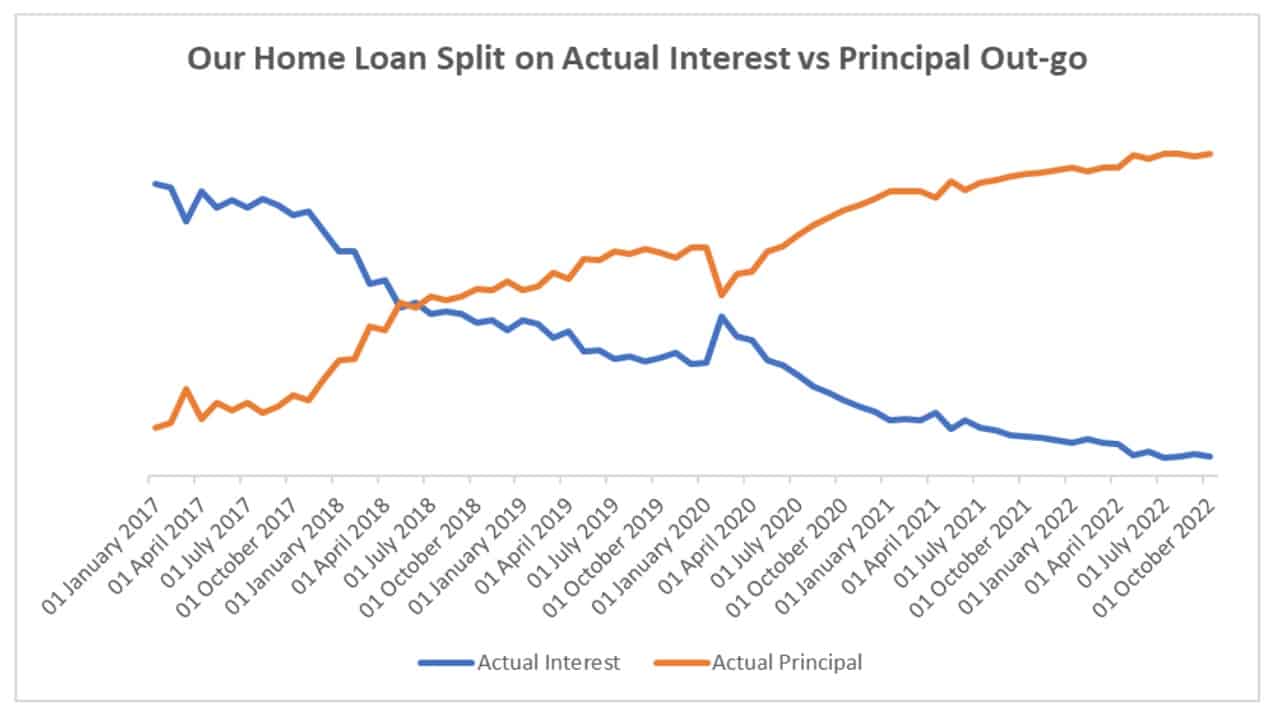
You can see that our interest went below the principal in about 15 months since we started with the Home loan. The spike seen in early 2020 is thanks to a withdrawal from the account for purchasing our first Car.
We could do that without going for a loan (Again, I felt proud of this decision we made when I learned a little later that going for a loan on liabilities is not a great financial decision).
I highlight this here because some arguments go against opting for a Maxgain-type home loan. While those reasons might be compelling, there is a case for opting for them.
You can use it as your short to medium-term investment option. It fares as well, if not better post-tax than other debt instruments, especially in a medium to high-interest rate environment. The interest you get to save is a loose equivalent of the interest you would get if you were to invest in other debt instruments) and this can also double up as your emergency fund, given its ability to stay liquid.
If I had known enough, I could even have used some of the money accumulated in it to purchase equity when the market hit its lows in early 2020, but that line of thinking doesn’t make a lot of sense as it is driven by the benefit of hindsight.
I am thankful my decisions before 2020 weren’t bad, given how limited my financial literacy was. It was in 2020 that I started following freefincal and a host of other resources to understand personal finance (behavioural and otherwise) better, and I am fascinated by the topic every passing day.
I have been able to course-correct our journey, and a few key realizations/actions I have had in the last 2.5 years have been: Gathering the knowledge on how asset allocation & estimating goals were more important than things like what specific product you want to purchase.
After going through the Freenfincal articles on quantifying retirement corpus, I got more clarity on what would constitute a good corpus for us to be financially free and what a sane and risk-controlled journey to that would look like in terms of asset allocation choices and what investments would make sense to get there.
The actual process of getting my allocations to the goal is something I am working on (I have a 60%:40% Equity Debt goal to maintain till I get to 44 and slowly taper it off to a 40%:60% in the decade after that). Given my late exposure to equity and the fact that I was doing EPF/VPF/PPF for several years, I am still on the path to getting to the 60%:40% with monthly allocations tilting a lot towards equity (more like 80%:20% till I get there).
Only time will tell if that would work very well in my favour. Past data indicates a high probability of that being the outcome, but nothing is guaranteed. I believe in the simplicity of a unified portfolio for our goals. Hence, the allocations referred to here are broadly for all medium to long term goals (retirement, kid’s education etc.).
The need to have a conviction on products you choose to ride with. My equity portfolio comprises mainly a couple of active funds managed by fund managers driven by Value-Investing and Contrarian investing approaches. After reading about the different styles, I feel I am comfortable with Value investing especially given I have a long runway before for the goals to mature for which I am investing in them.
However, the logic behind passive investing made it irresistible for me to avoid it. So, around 25% of my equity portfolio is going into a Nifty50 Index fund (I know Pattabiraman sir may not be pleased with it given his suggestion on sticking either with Active or Passive, and I agree it doesn’t make a lot of sense going both ways, but this has been more of an emotional choice and an exciting experiment that I can track and measure down the road on which part of it worked out well for me).
The need for building an emergency corpus. Our OD account serves the purpose for now. Still, the plan is to continue to accumulate more and have it in overnight fund /long term bond type instruments to get that flexibility to balance my asset allocations better. I am reading about that to better understand debt options in the Bonds space, but I may want to use the services of a Fee-only RIA to make the right choices there.
The need for term and health insurance, I have already got one after spending a good time estimating the needs of the family for life if I were to cease existing anytime from now.
One pending action is to go for proper health insurance outside the employer-provided. I am still researching a bit and hoping to get that done within the next year or so.
Parents are beyond 70 and without health insurance of their own. So, have enrolled them on employer insurance for some extra premium and building a war chest of sorts to handle any unexpected emergencies is the plan there. If anyone from the Freefincal community knows other options I can go with for them, please feel free to educate me.
All said, my wife & I are now at a point where the combined net worth (not including primary residence here) of my wife & I is around 18x our yearly expenses. With a decent amount of runway left and given our healthy savings rate, we would want to take it to 40x-45x over the next ten years to make our life choices entirely independent of our financial needs.
Some of you hopefully found this interesting, with a few points resonating with your journeys or with some clarity on what to do and what not to do based on my journey so far. Thank you, Pattu sir, for providing me with the platform to share my journey with fellow FreeFincal followers.
Reader stories published earlier
As regular readers may know, we publish a personal financial audit each December – this is the 2021 edition: Portfolio Audit 2021: How my goal-based investments fared this year. We asked regular readers to share how they review their investments and track financial goals.
- First audit: How Suhas tracks his MF investments and reviews financial goals.
- Second audit: How Avadhoot Joshi evaluates his investment portfolio.
- Third audit: How a single mom is on track to financial freedom
- Fourth audit: How Gowtham started goal-based investing & took control of his money
- Fifth audit: Why my financial independence & early retirement plans were postponed by four years
- Sixth audit: How Abhisek funded his marriage & is on track to financial freedom.
- Seventh audit: How Rohit’s early struggles defined his investment journey
- Eighth audit: Why my investments are still on track despite job loss and lower-income
- Ninth audit: How a retirement planning calculation scared me to take action
- Tenth audit: I made several investment mistakes but have turned my life around.
- Eleventh audit: My net worth doubled in the last financial year, thanks to patient investing!
- Update: How I achieved investing nirvana.
- Twelveth audit: My financial journey: from novice to goal-based investor.
- Thirteenth audit: My journey: from a negative net worth to goal-based investing.
- Fourteenth audit: From Fixed Deposits to Goal-based investing in MFs.
- Fifteenth audit: My 10-year financial journey – mistakes made and lessons learnt.
- Sixteenth audit (part 1): How I achieved financial independence without mutual funds or stocks.
- Sixteenth audit (part 2): Lessons from my financial independence journey and future investment plans.
- Seventeenth audit: How I plan to achieve financial independence and move to my native place
- Eighteenth audit: I used the current bull run to reduce my mutual funds from 14 to 4!
- Nineteenth audit: How a conservative investor created his financial plan
- Twentieth audit: I plan to achieve financial independence by 46; this is my master plan
- Twenty-first audit: I have made many investment mistakes but am on course to financial independence by 45.
- Twenty-second audit: I felt worthless six years ago but have achieved financial stability today
- Twenty-third audit: My financial journey was directionless until age 40: this is how I made up for lost time
- Twenty-fourth audit: Why I increased equity MF investments by 275% and reduced PPF contributions.
- Twenty-fifth audit: How I track financial goals without worrying about returns
- Twenty-sixth audit: I am 24 and started investing 1Y ago, but what am I investing for?
- Twenty-seventh audit: How we plan to achieve a retirement corpus 50 times our annual expenses.
- Twenty-eighth audit: I thought equity investing was a gamble, but now I aim to hold 60% equity for retirement
- Twenty-ninth audit: My journey: From 5 lakhs in debt to building a corpus worth six years in retirement
- Thirtieth audit: My investment journey: From random purchases to a goal-based portfolio
- Thirty-first audit: My investment journey: from product-driven to process-driven
- Thirty-second audit: How a young couple is trying to balance travelling and investing
- Thirty-third audit: My journey: From Rs. 30 bank balance to financial independence
These published audits have had a compounding effect on readers. If you would like to contribute to the DIY community in this manner, send your audits to freefincal AT Gmail. They could be published anonymously if you so desire.