Last Updated on August 30, 2021 at 3:49 pm
The correlation between mutual fund returns and the upside/downside capture ratios is discussed using Mid-cap mutual funds. It is no secret that I am a fan of the downside capture as a simple means of measuring downside protection, selecting and reviewing mutual funds.
In this post, the recently obtained downside Capture Ratio of all Mid-cap Equity Mutual Funds is used for analysis.
Downside capture refers to the amount of benchmark losses captured by the fund. That is, a fund which has only captured 70% of benchmark losses is considered better than a fund which has captured 80% of losses. This ratio (expressed as a percentage) is known as downside capture. Lower the downside capture the better.
Upside capture refers to the amount of benchmark gains captured by the fund. That is, a fund which has captured 110% of benchmark gains is considered better than a fund which has captured 90% of gains. This ratio (expressed as a percentage) is known as upside capture. Higher the upside capture the better.
🔥Secure your future with our Robo-advisory tool trusted by over 3,500 investors and advisors. From effortless retirement planning to funding your children’s biggest dreams, turn your financial goals into reality. 🔥
Subscribe for money management solutions via email! (Link takes you to our email sign-up form) Join 32,000+ readers in our community.
👉 New Tool Alert! NaviPlan: A Privacy-Focused Multi-asset Tracker and Goal Planner 👈
Capture ratio = upside capture/downside capture. A value greater than 1 is considered ‘good’ as it implies high upside and low downside.
The reason I like the downside capture or its brother the upside capture is because they are simple to understand and do not have the limitations associated with other popular risk-adjuted metrics like alpha, Sharpe ratio, Sortino ratio, standard deviation etc.
More about the downside capture and upside capture can be found in the following posts:
- Simplify Mutual Fund Analysis with Upside/Downside Capture Ratios
- Understanding Upside and Downside Capture ratios
- How Mutual Fund Upside and Downside Capture Ratios are calculated.
Nine year Returns
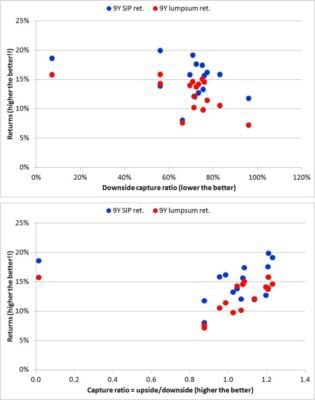
Unfortunately, the analyzer could only calculate for a handful of funds over this duration. Although there is a general sloping trend from left to right, there is also a considerable spread in returns for a given downside capture or vice versa.
Higher the capture ratio, higher the return is the ‘general trend’ with the spread as mentioned above. Notice that one fund is an outlier. This has an unusually low upside capture which makes the capture ratio small.Will have to investigate further into this.
It is important to note that each capture ratio is calculated with reference to a different benchmark (that of the funds). I believe this is the main reason for the scatter.
Eight-year returns
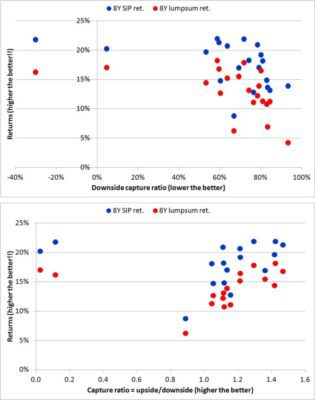
The spread in downside is much higher compared to the capture ratio. Aside from the presence of outliers, the capture ratio does have better correlation with returns than just the downside capture.
Data for other durations can be found in this slideshow. Data over short durations is included only for completeness. Not much can be made out of these.
