Last Updated on November 16, 2025 at 12:36 pm
Parag Parikh Financial Advisory Services has filed an NFO document for Parag Parikh Large Cap Fund with SEBI. I was initially reluctant to opine on it, but since we received several requests, I thought I would throw in my two cents. Note: this is only at the filing stage. Post-approval, the launch (if the AMC decides to go ahead) will take place in the coming months.
Before we begin, I have a personal bias for the fund house (I hold three of their funds, with a huge weight in their flexicap fund, where I am a since-NFO investor). See: Auditing my retirement portfolio for Mint Newspapers Guru Portfolio and 17 years of mutual fund investing: My Journey and lessons learned.
However, as things stand, I will neither invest* nor recommend the Parag Parikh Large Cap Fund, and it will not feature in our quarterly Handpicked list of Mutual funds (PlumbLine). The simple reason is that most active funds** struggle to beat benchmarks, and investors can invest in the Nifty 50, Nifty 100, or Nifty 500 based on their FOMO levels. See: Nifty 50 or Nifty 500, which index fund should I choose?
* 10 years ago, I might have, but today I am too bored and too tired to worry about my portfolio and am at a “do nothing” phase.
🔥Secure your future with our Robo-advisory tool trusted by over 3,500 investors and advisors. From effortless retirement planning to funding your children’s biggest dreams, turn your financial goals into reality. 🔥
Subscribe for money management solutions via email! (Link takes you to our email sign-up form) Join 32,000+ readers in our community.
👉 New Tool Alert! NaviPlan: A Privacy-Focused Multi-asset Tracker and Goal Planner 👈
** Most investors incorrectly believe that only active large cap funds fail to beat benchmarks consistently. This is true also of mid and small cap funds too!
The NFO filing of Parag Parikh Large Cap Fund (note: an NFO filing does not mean it will be launched) is a curious choice IMO. This is because, given the popularity with unitholders, they could have filed for a mid cap or small cap fund (they still might in future!) and raked in the AUM.
Instead, they have opted for the large cap space, which is saturated with old heavyweights. The SEBI rules may not allow them much wiggle room to outperform significantly. They must hold at least 80% in large caps. According to the filing (subject to change), they also would like to invest a bit in REITs and InvITs, a bit in mid cap or small cap stocks, a bit in international equity and a bit in bonds.
Given their reputation, I expect the large cap to be less volatile than, say, the Nifty 100. But will it outperform is another matter, but I wouldn’t put it past them either. However, their reputation is not enough to commit money to this fund. We recommend that interested investors wait for a significant period before deciding (but there is little point in waiting!).
The AMC has said it will explain its choice in forthcoming unitholder meetings. But it is the performance that counts. I am sure the AMC would have brainstormed different ideas and also anticipated at least some of the criticism aimed at this filing. They would not have gone ahead if they had not anticipated considerable inflow.
In a recent article, we have shown how the Parag Parikh Flexi Cap Fund is almost a large cap fund due to its high AUM Will Parag Parikh Flexi Cap Fund’s large AUM affect its performance?
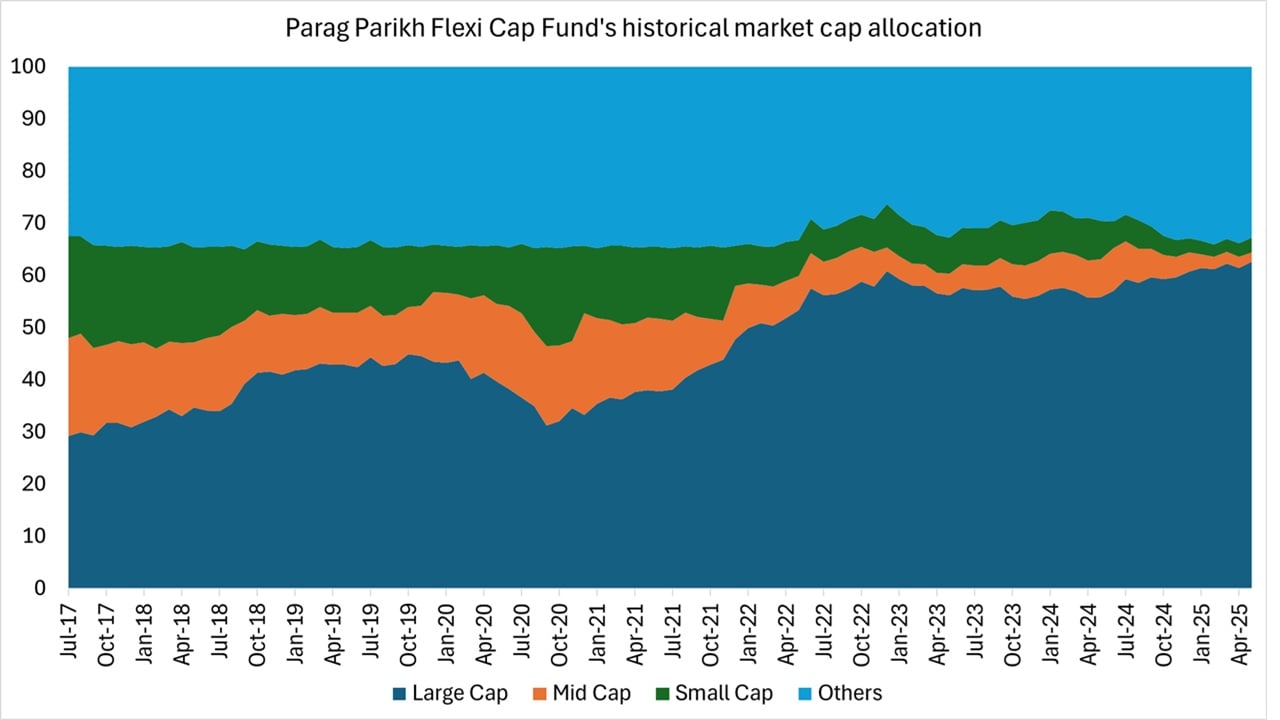
So there is considerable criticism on social media that the large cap fund will serve as an alternative low AUM fund for AMC fanboys to get some international exposure or retirees to get dividends.
This is fair as it would be hard to differentiate oneself in the large cap space compared to the AMC’s recent launches like Parag Parikh Dynamic Asset Allocation Fund and Parag Parikh Conservative Hybrid Fund.
When the Flexicap fund was launched, its “go anywhere” mandate was a USP. Burgeoning AUM and SEBI MF category restrictions, along with RBI’s international AUM limitations, have severely limited the fund’s ability. Much of the fund’s returns I enjoy today are probably from when it was less popular.
According to AMFI, about 65% of the Flexicap AUM is in the direct plan (the rest is in the regular plan via distributors). Will the large cap fund be as popular among direct plan investors?
All that aside, I do admire the fund for not chasing AUM and opting for a large cap fund launch (as of now). How successful it will be remains to be seen. Often, it is better to watch from the sidelines without committing money. This seems like one such time. But then again, the future is unpredictable.