Last Updated on December 29, 2021 at 6:28 pm
Aakash, who is 24, asks, “My goal is Financial Independence in 20-25yrs from now. I am rooting for lazy investing and rebalancing. Monthly expenses will be 40k/p.m. and I will be able to invest 40-45k p.m. My request is to take my case and please explain whether it is too late to retire early at 40-45 age with Corpus 10 Crores and If I am on the right track.”
Aakash is currently pursuing a PG degree after having worked for a year. He will resume work after graduation next year. Other details shared:
- Liquidity in the Bank: ~4L
- Stocks: ~1.7L (Large- 60%, Mid-30%, Small -10%)
- MF: ~1.5L (Axis Blue Cp – 50%, Axis Small Cap – 20%, Nippon Pharma – 20%, ICICI Prud US Blue cp Eq – 10%)
- Others: ~ 80k( Need to Transfer from Trust to EPF)
- Term Insurance: 1cr with 900 premium / p.m. for 45 yrs.
Before we begin, we recommend Aakash buy a health insurance policy. This will help with the selection: SEBI RIA Melvin Joseph releases a free e-book: Health Insurance Simplified.
Let us punch the numbers provided by Aakash into the freefincal Robo Advisory Tool with the following assumptions:
🔥Secure your future with our Robo-advisory tool trusted by over 3,500 investors and advisors. From effortless retirement planning to funding your children’s biggest dreams, turn your financial goals into reality. 🔥
Subscribe for money management solutions via email! (Link takes you to our email sign-up form) Join 32,000+ readers in our community.
👉 New Tool Alert! NaviPlan: A Privacy-Focused Multi-asset Tracker and Goal Planner 👈
- Inflation before retirement (%) 8
- Inflation during retirement (%) 8
- Years to retirement 20
- Monthly expenses in the first year of retirement 1,86,438 (the current 40K would have inflated to this 20 years from now
- Years in retirement 46 (until age 90)
- Post-tax return expected from equity investments 10%
- Rate of return expected from current tax-free fixed income 7%
The total corpus required is Rs. 9.85 Crores. Aakash’s estimate is excellent. If we factor in his existing investments (excluding the Rs. 4L in a bank), then the corpus to be accumulated is Rs. 9.60 Crores. This is the suggested asset allocation schedule.
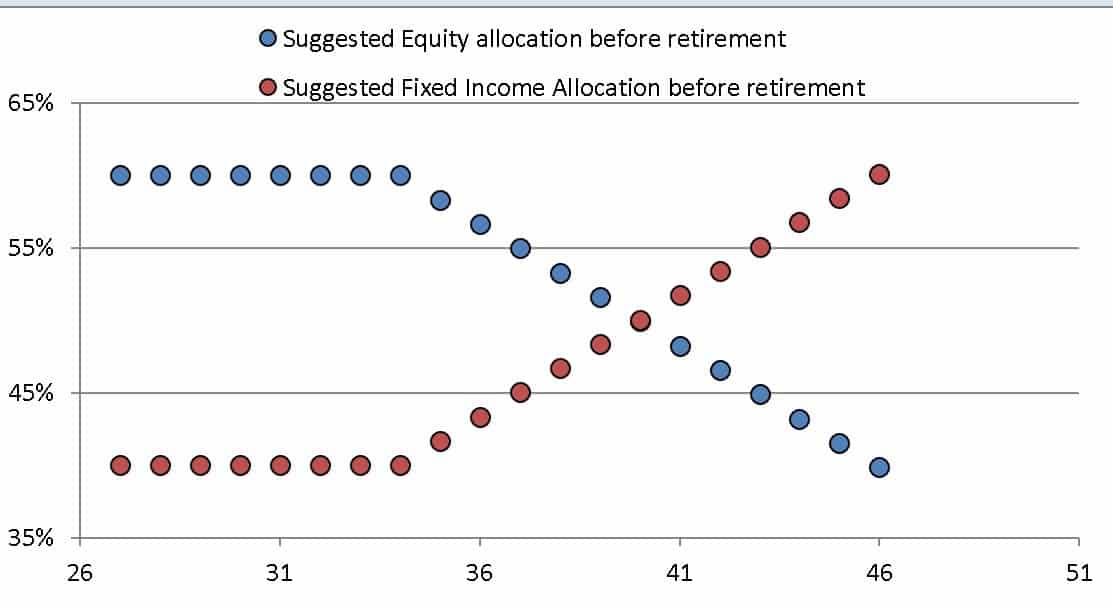
If Aakash can increase his monthly investments by 10% each year, his initial investment for financial freedom is Rs. 41,000. So the answer to his question, “Can I retire in 20-25 years if I invest an amount equal to my expenses?” is Yes!
Suppose he increases his retirement age by five years – that is, retirement at age 51 (25 years of investing), the retirement corpus increases to Rs. 13.14 Crores. After taking existing investments into account, it is Rs. 12.75 Crores.
Curious to know why the retirement corpus has increased so much? Read more here: Retire early to lower your retirement corpus! The total investment to be made is Rs. 46, 500 increasing at the rate of 10% a year. This will result in a different asset allocation schedule.
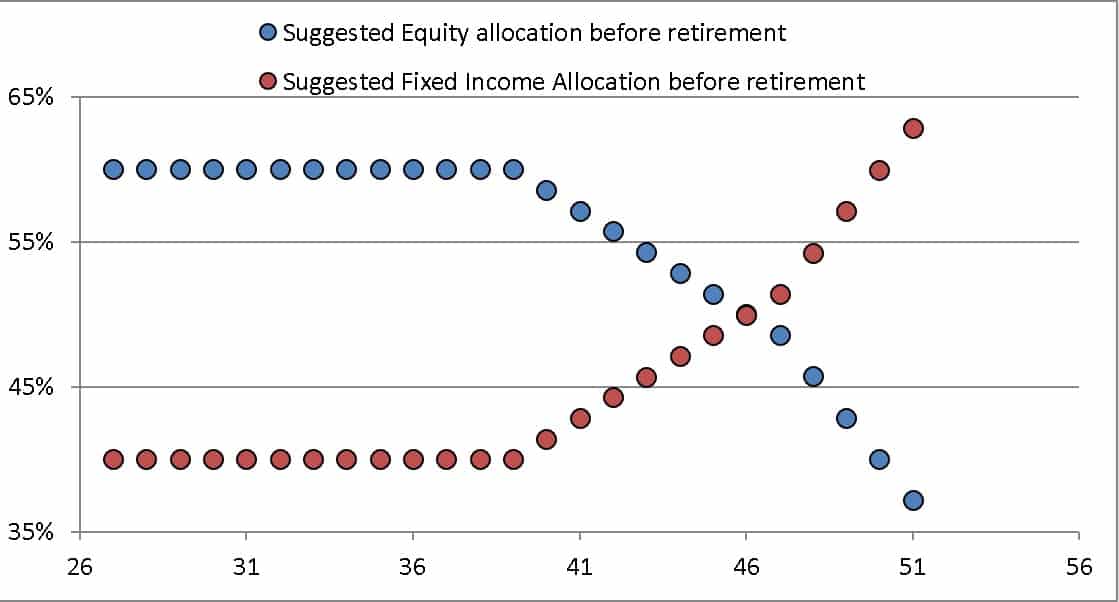
These calculations also take into account a retirement bucket strategy. The retirement corpus is assumed to be invested in five buckets. Overall asset allocation is about 65% fixed income and 35% equity.
- An emergency bucket to handle unexpected expenses.
- An income bucket provides guaranteed income for the first 15 years in retirement. During this time, investments are made in the following three buckets.
- Corpus from a low-Risk bucket that provides income from year 16 to year 25 in retirement. The low-risk bucket will have an asset allocation of 50% equity 50% debt during the investment period (years 1 to 15 of retirement) to provide this income.
- Corpus from a medium risk bucket will provide income from year 26 to 33 in retirement. To provide this income, this bucket shall have an asset allocation of 70% equity and 30% debt during the investment period (year 1 to year 25)
- Corpus from a high-risk bucket will provide income from years 34 to 41 in retirement. To provide this income, this bucket shall have an asset allocation of 100% equity during the investment period (year 1 to year 33)
- A fully worked out example for these retirement buckets is available: I am 30 and wish to retire by 50; how should I plan my investments?
In summary, Aakash is on the right track. However, he should repeat the retirement planning calculation once a year with fresh inputs (expenses) and fresh assumptions (returns after-tax, inflation estimate etc.) to account for changes in circumstances and lifestyle.