Last Updated on December 29, 2021 at 5:56 pm
This is my monthly retirement stock portfolio update compared with an equivalent investment in a Nifty index fund. Before we begin, it is important for investors to appreciate the context of these investments.
I started direct equity investing only after achieving a comfortable level of financial independence and ensuring my son’s future portfolio is in a good place. So this is largely an experimental portfolio. At the time of writing, its value is just 20% of my equity MF retirement portfolio and about 11% of my total retirement portfolio.
It is experimental in the sense, I invest without the fear of performance. There is not experimentation in the stock selection strategy. That is often a waste of time and therefore a waste of true wealth.
My goal is to buy stocks with practically zero research. I continue to invest normally in mutual funds. For detail’s see: How my retirement portfolio has performed in 2020: personal finance audit.
🔥Secure your future with our Robo-advisory tool trusted by over 3,500 investors and advisors. From effortless retirement planning to funding your children’s biggest dreams, turn your financial goals into reality. 🔥
Subscribe for money management solutions via email! (Link takes you to our email sign-up form) Join 32,000+ readers in our community.
👉 New Tool Alert! NaviPlan: A Privacy-Focused Multi-asset Tracker and Goal Planner 👈
I have purchased mutual funds all these years each month regardless of market levels and I shall strive to copy this uninteresting strategy for direct equity as well. If I have the money that is, and this month I do not. So the last investment made was on 1st March 2021.
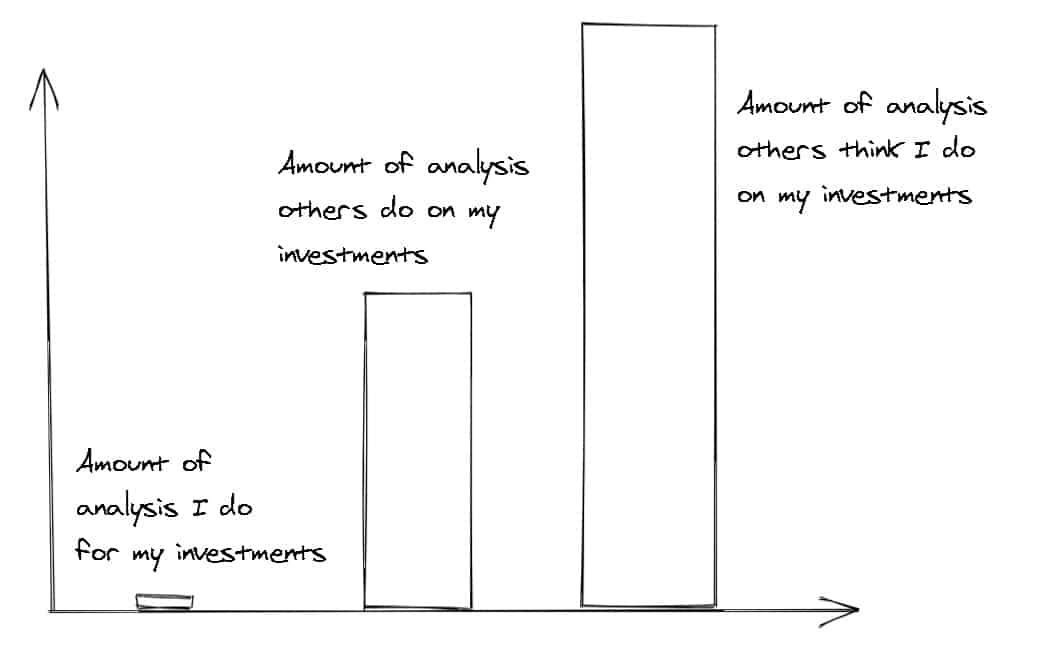
Time is not just money; Time is unquantifiable money. Time wasted in stock analysis or mutual fund analysis; the right time to invest etc is an unquantifiable loss. So my goal is to buy a fund or stock within a minute.
There is zero-skill involved in any aspect of my portfolio. I compensate for the lack of knowledge with discipline. Randomness (aka luck) plays a huge role in the return numbers you see below. I have already discussed a monkey portfolio and how mine is one.
I got the confidence to invest in stocks after evaluating the performance of low volatility indices. I told myself I am not going to do any stock analysis or research. A quick check of company health, a brief review of volatility and buy. If I cannot buy a stock within a few minutes, I am wasting time and money (in that order).
The way I see it, the stock portfolio is part of my retirement portfolio basket as a dividend source. It is also part of my emergency fund. Maybe I will find another use for It in future.
In FY 2020-21, the total dividend income from this portfolio is about 30% of my current monthly expenses. The next goal is to receive one month’s expenses as a total quarterly dividend. I do not consciously reinvest dividends. Younger people should. For me, it matters little, as long as the overall investment made each month keeps growing at a healthy pace.
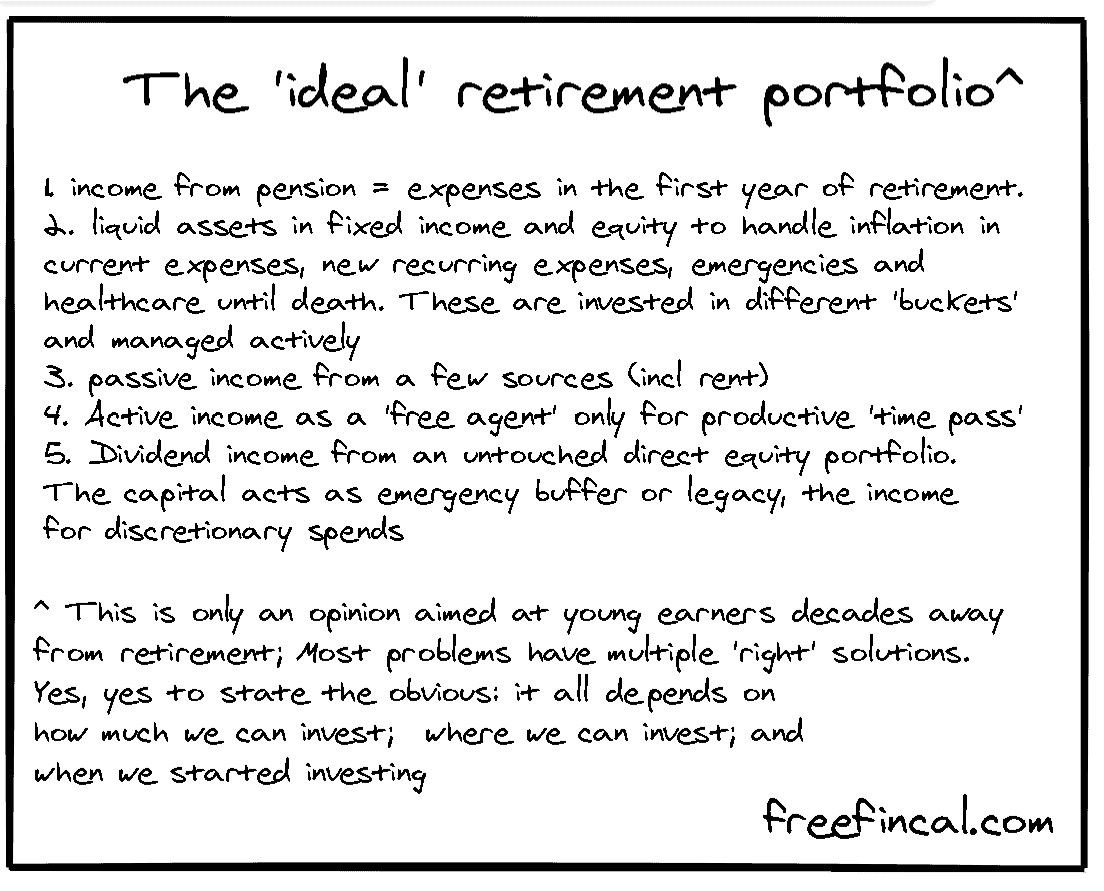
This stock portfolio is part of my overall retirement portfolio. I am striving to build the ideal retirement portfolio. Also, see: How to build a second income source that will last a lifetime
Caution: No part of this article should be treated as investment advice. I started investing in stock after my goal-based investing was in place.
Stock picking strategy
- Choose stocks with little or no evaluation or analysis.
- Choose low volatile stocks with sound financial health (low debt min requirement)
- Choose stocks that tend to trade close to their all-time highs (approx momentum indicator). See for example A list of stocks that have traded close to their “all-time high:
- Do not be afraid to pick expensive stocks – both in absolute price and valuation. Note: Value investing may sound intelligent and enticing, but it is essentially riskier. I neither have the age to take on such a risk, nor the qualitative insights to pick stocks that the market has shunned but will be discovered sooner than later. To appreciate the risk associated with value investing and why it is more qualitative than quantitative, see this analysis: Is it time to exit ICICI Value Discovery & Quantum Long Term Equity?
- When in doubt, ask your wife when she is just about to fall asleep in the afternoon.
- Do not fear dividends (or dividend taxation).
- What matters primarily is company health. Whether it is a dividend payer or not is incidental. That is, it makes no sense to say no to a company only because it pays huge dividends! Just as it makes no sense to sell a stock because it has increased dividend payout.
- All stock investors over a period of 10 plus years will receive dividends whether they like it not. There is no choice, unlike mutual funds.
- Dividends are not something “extra” in terms of returns/performance but do represent real profit. It can serve as a source of income for an older investor: How to build the ideal retirement portfolio. Younger investors will never understand this and that is fine.
- Peaceful sleep is the best form of realised gains: hence the importance to business health, low volatility, reasonable momentum (not all stocks in my portfolio will check all these boxes).
- This is the archive of previous portfolio updates.
Related videos: How to buy your first stock without breaking your head
Retirement Stock Portfolio April 2021
Please note: Although investments started in 2014, about 67% of the total invested amount is within the 7 months. So do not take the return nos seriously.
| Instrument | Weight as of April 12th 2021 |
| ASIANPAINT | 16.33% |
| HINDUNILVR | 15.54% |
| TCS | 14.23% |
| INFY | 12.92% |
| PIDILITIND | 10.85% |
| HDFCBANK | 10.41% |
| DABUR | 7.97% |
| COLPAL | 5.21% |
| ITC | 2.81% |
| WIPRO | 1.88% |
| MARICO | 1.85% |
- Dividend Return = Total Dividends divided by Total Investment
- Capital Gain (CG) Returns = Total CG divided by Total Investment
- Total Return = Dividend Return + CG Return.
- CAGR = ( 1 + Total Return ) ^ ( 1 / Avg. Years) – 1 => Avg. year = 0.7 in this case.
- All returns before tax.
- The stock split in HDFC Bank and Colgate has complicated this calculation. I need to check independently if the numbers are correct.
| Stock | Capital Gain | Dividends | Total Return |
| COLPAL | 12.49% | 2.10% | 14.59% |
| DABUR | 7.46% | 0.36% | 7.82% |
| HDFCBANK | 38.76% | 0.44% | 39.20% |
| HINDUNILVR | 23.51% | 1.84% | 25.35% |
| PIDILITIND | 19.81% | 0.16% | 19.97% |
| ASIANPAINT | 27.77% | 0.29% | 28.07% |
| INFY | 32.07% | 0.89% | 32.96% |
| WIPRO | 7.36% | 0.17% | 7.54% |
| TCS | 22.89% | 0.63% | 23.52% |
| ITC | 0.32% | 4.06% | 4.39% |
| MARICO | 2.99% | 1.65% | 4.64% |
| Total portfolio (absolute return)* | 21.44% | 1.01% | 22.45% |
| CAGR* | 27.24% | 1.31% | 28.55% |
| UTI Nifty index fund (absolute return)* | 18.64% | ||
| UTI Nifty index fund (XIRR)* | 19.46% |
* Total return and CGAR includes liquidated holdings (see monthly update archives for details)
Note: The dividends in the stock portfolio are not assumed to be reinvested. Such a calculation is significantly harder. If done the stock portfolio return would be a bit higher. The above numbers are only approximate.
Comparison with Nifty: if the same investments had been done in UTI Nifty fund direct plan, the total return would be 18.64% (compared to 22.45% for the stock portfolio). The XIRR of the Nifty investment would be 19.46%. Regular readers would appreciate a massive fluctuation in the XIRR. This is because the portfolio is quite young and annualized returns should not be taken too seriously
The XIRR of the stock investment was not computed (due to complications from dividends and splits). The beta of the stock portfolio (relative volatility compared to the market) is 0.43 – about 57% less volatile than the “market”. I have fun building this “monkey portfolio” with no effort and am going to continue. Please do your own research and invest.