Last Updated on August 22, 2022 at 11:14 pm
Investors can create a simple, minimalistic two-fund equity mutual portfolio by investing in a Nifty index fund and a Nifty Next 50 index fund. While one should rebalance between asset classes, for example between equity and fixed income, in a standard two-asset class portfolio, should one rebalance between Nifty and Next 50?
If you are wondering how NIfty and NIfty Next 50 funds are that one needs for an equity portfolio, see: Combine Nifty & Nifty Next 50 funds to create large, mid cap index portfolios. If you want help selecting these index funds see: Which Nifty Index Fund has the lowest tracking error? and What is the best way to invest in Nifty Next 50 Index? and Which Nifty Next 50 index fund has the lowest tracking error?
To answer yes or no to the titular question we can only conduct a backtest from Dec 2002. We can make some observations without any testing. Although Nifty Next 50 (NN50) is significantly more volatile than the NIfty -in fact NN50 is not a large cap index, never mind what SEBI thinks – there is a good deal of correlation between their movements.
🔥Secure your future with our Robo-advisory tool trusted by over 3,500 investors and advisors. From effortless retirement planning to funding your children’s biggest dreams, turn your financial goals into reality. 🔥
Subscribe for money management solutions via email! (Link takes you to our email sign-up form) Join 32,000+ readers in our community.
👉 New Tool Alert! NaviPlan: A Privacy-Focused Multi-asset Tracker and Goal Planner 👈
That is if one falls/rise, the other tends to fall/rise – although the movement from Feb 2018 has been frustratingly inhomogenous – this means the benefits of rebalancing if any is likely to be small. It is still incumbent upon us to test it out.
We shall look at seven and ten-year SIPs in the Nifty and Nifty Next 50 with a 50:50 allocation. This is a mere 128 7-year runs and 92 10-year runs. Hardly conclusive, but we will have to work with what we can.
Note: this only considers a 100% equity portfolio. The benefit of rebalancing between equity and debt is indisputable as discussed earlier: Forget tax and exit loads, this is why your portfolio should be rebalanced each year. If you need additional help, consult, How to Rebalance Your Investment Portfolio and When should I rebalance my portfolio?
So if you hold Nifty and Nifty Next 50 along with fixed income, you anyway be rebalancing between fixed income and both equity funds. We are only considering if an additional “reset” between the two equity funds is necessary for this article.
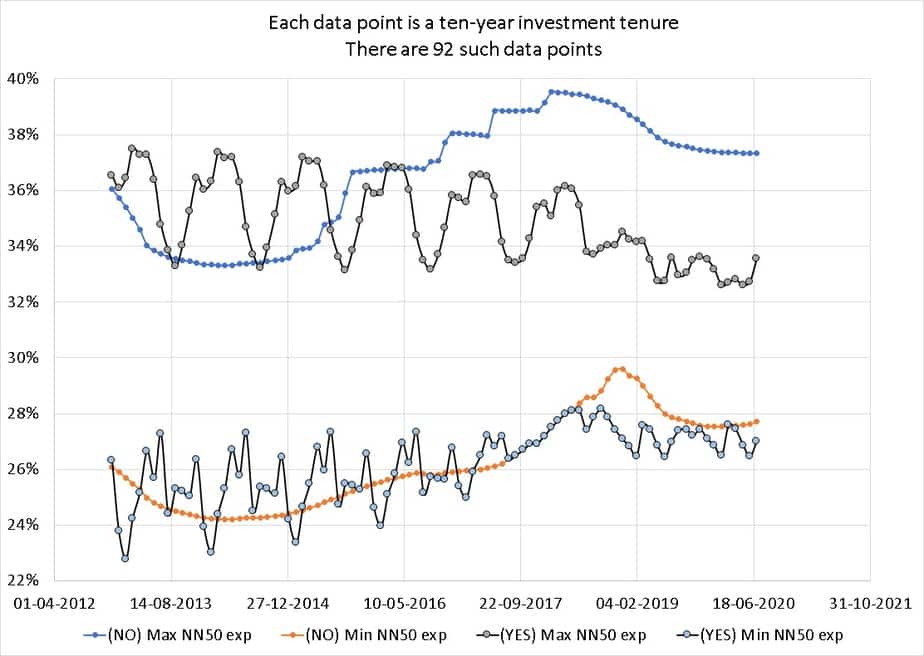
For a 50% Nifty and 50% Nifty Next 50 portfolio this is max and min variation in NN50 asset allocation over 7 and 10 years. That is, for each of those 128 7-year runs, the max NN50 allocation over the 7x 12 months and the min allocation is plotted
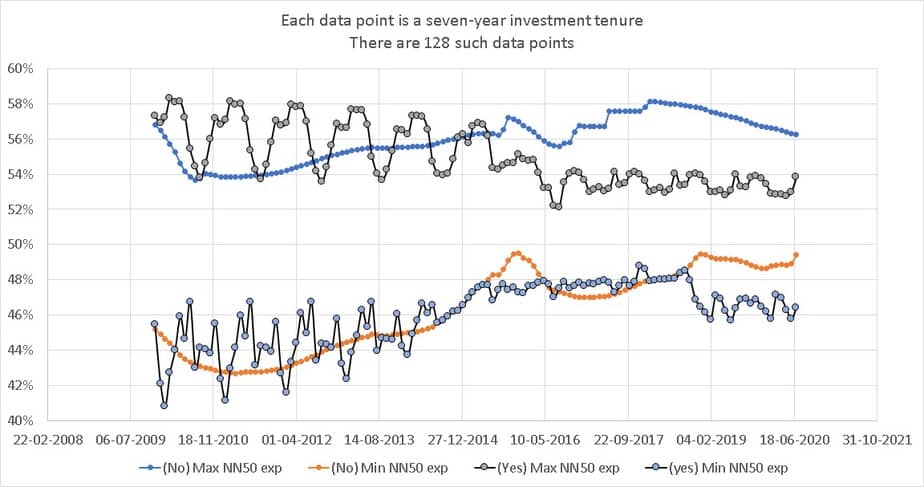
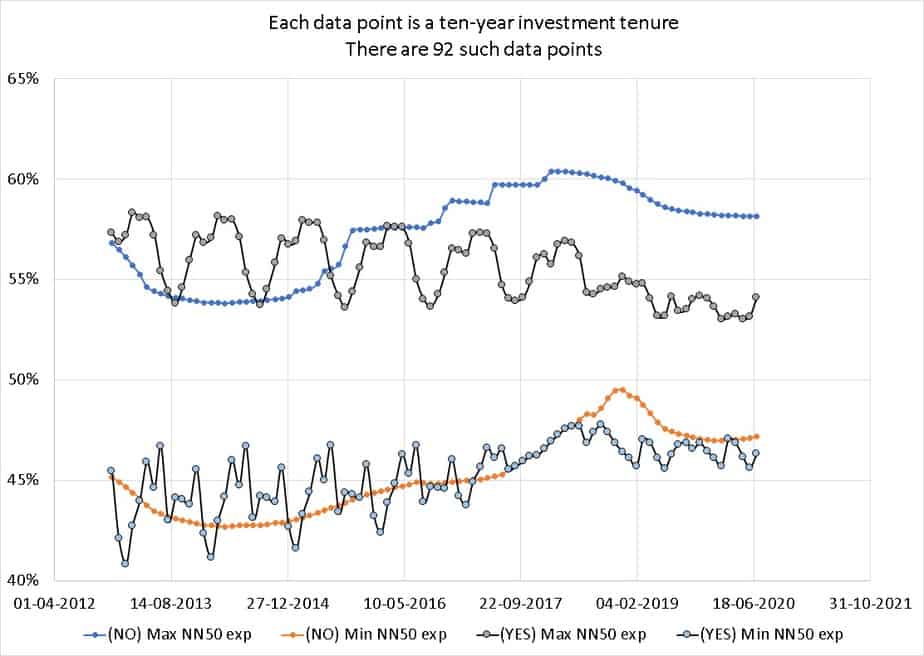
Notice that the deviation is not significant. This means that the impact of rebalancing between Nifty and Nifty Next 50 is insignificant. This can also be seen from the standard deviation (volatility) and max drawdown (extent of max fall from peak).
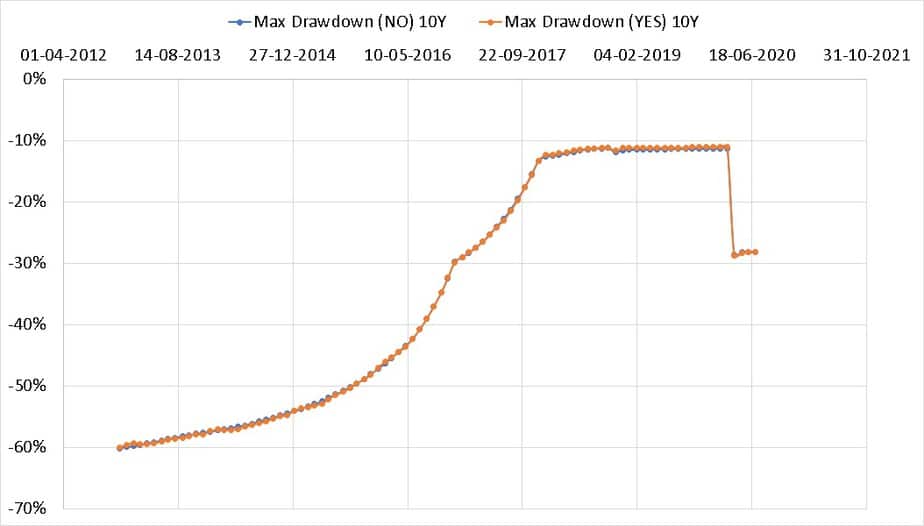
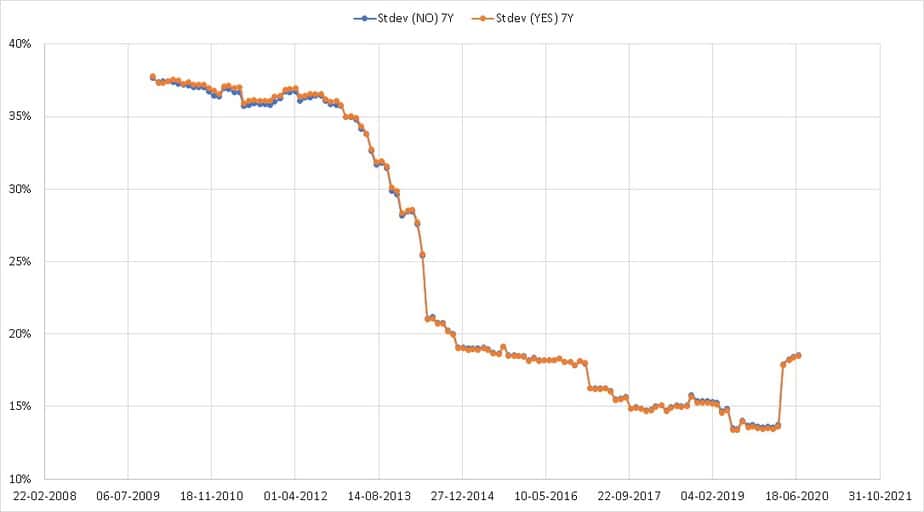
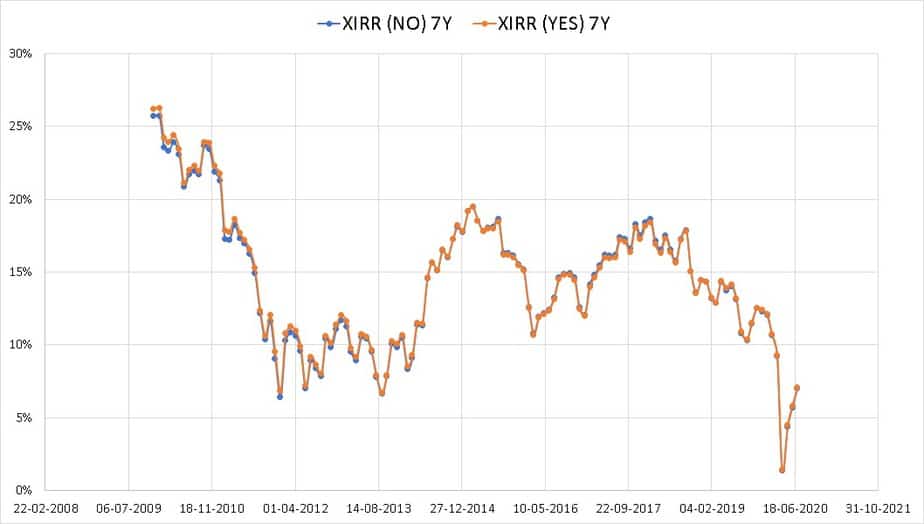
There is no difference in the returns (XIRR) as well.
Even for a 70% Nifty 30% Nifty Next 50 allocation, the deviation in asset allocation is not significant. The other metrics like MAx drawdown and standard deviation also do not vary much as above.
What does this all mean? All investors need to do is to rebalance systematically (once a year) between equity and debt. There is no need for an additional rebalance bet Nifty and Nifty Next 50. Suppose the portfolio has 70% nifty and 30% Nifty Next 50. If Rs. 1000 needs to be added to removed from equity to debt or vice versa, then Rs. 700 can be the contribution from Nifty and Rs. 300 from Nifty Next 50.
In other words, the debt to rebalancing can be done without disturbing the Nifty Nifty Next 50 weights. If at the time of rebalancing there is a significantly disparity in their weight then it can be “reset” as well -which is a natural thing to do. For example in the last couple of years, Nifty has moved up and NN50 down. So at the time of equity-debt rebalancing, more (or all the) profit can be removed from Nifty to debt.
Further considerations: We have already seen tactical asset allocation between equity and debt (gilts) using double moving averages has worked well. Would tactical asset allocation between Nifty and Nifty Next 50 make a difference? We shall consider this in a future post.