Regular readers may be aware that we often discuss a retirement bucket strategy. In this article, we discuss the possibility of building retirement buckets using hybrid funds. The main advantage of using hybrid funds is less management. We do not have to worry about asset allocation changes. The churn among buckets can be minimised. Also see: Implementing a retirement bucket strategy with minimal churn.
However, there are significant risks as well. (1) Funds can change their mandate, which costs the retiree tax if they need to exit fully or partially. (2) Investors may not appreciate all risks before investing. (3) These suggestions are not for investors (even if we assume they have enough corpus for a bucket strategy). So please proceed with caution.
At the time of writing, there are no pure passive hybrid funds (we do not include fund-of-funds products in which the fund managers can actively change the underlying passive funds). If you prefer passive options, you will need to build the buckets using separate equity and fixed-income products.
Note: Lower churn among the buckets with hybrid funds does not mean zero churn. You will still need to keep an eye on it once a year and course correct as necessary, as per your intended plan (which is a prerequisite!).
List of hybrid funds:
🔥Secure your future with our Robo-advisory tool trusted by over 3,500 investors and advisors. From effortless retirement planning to funding your children’s biggest dreams, turn your financial goals into reality. 🔥
Subscribe for money management solutions via email! (Link takes you to our email sign-up form) Join 32,000+ readers in our community.
👉 New Tool Alert! NaviPlan: A Privacy-Focused Multi-asset Tracker and Goal Planner 👈
- Aggressive Hybrid (65% to 80% equity)
- Conservative Hybrid (10% to 25% equity)
- Balanced Hybrid (40 to 60% equity)
- Dynamic Asset Allocation/Balanced Advantage Fund (manager shifts allocation)
- Multi-Asset Funds (3+ asset classes like gold)
- Arbitrage Fund (bonds + min 65% hedged equity)
- Equity Savings (min 65% of hedged equity + equity)
A bucket strategy is a post-retirement investment plan to manage inflation-protected withdrawals (income) and investments for the near and long term. So, we have investments for income generation (regular withdrawals), fixed income, and equity.
Retirement buckets are mental partitions of these investments. The primary rule in our robo advisory tool is that the retiree should have enough money to generate inflation-proof income for the first 15 years of retirement. If this is not available, creating a bucket strategy is quite risky. A few years of poor market returns, especially in the first few years of retirement, can wipe out much of the corpus.
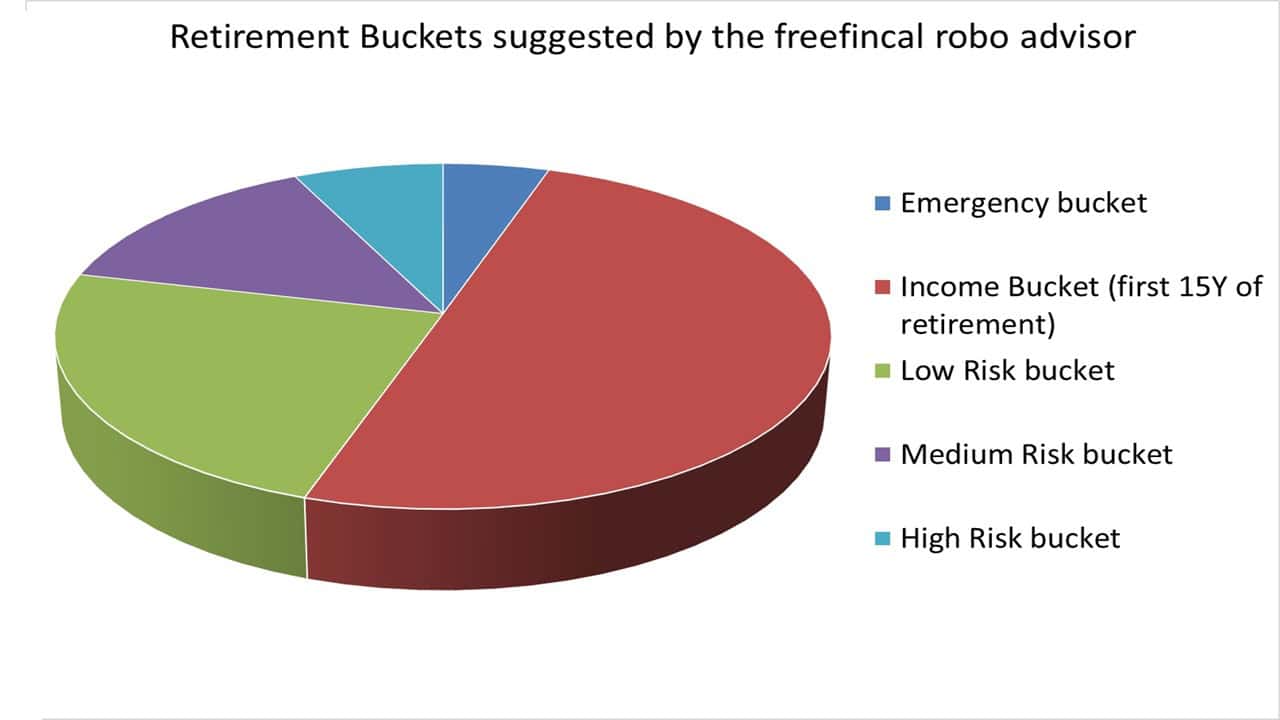
The robo tool divides the retirement corpus into five buckets. That is, the retirement corpus will be divided into five parts. This is only one of many ways to construct a bucket strategy. The idea here is to minimise active management and shift funds from one bucket to another unless necessary. The following assumes 45 years in retirement. The percentages are specific to the set of inputs and should not be used by everyone.
- An emergency bucket to handle unexpected expenses. Example: 5%
- An Income bucket for guaranteed income for the first 15 years of retirement. During this time, investments are made in the following three buckets. Example: About 40-45%. This is the bucket mentioned in the reader’s question.
- Corpus from a low-risk bucket that provides retirement income from year 16 to year 26. To provide this income, the low-risk bucket will have an asset allocation of 30% equity and 70% debt during the investment period (years 1 to 15 of retirement). Say about 25%.
- Corpus from a medium-risk bucket will provide retirement income from years 27 to 35. To provide this income, this bucket shall have an asset allocation of 50% equity and 50% debt during the investment period (year 1 to year 26). Say about 10-15%.
- Corpus from a high-risk bucket will provide retirement income from years 36 to 45. To provide this income, this bucket shall have an asset allocation of 70% equity and 30% debt during the investment period (year 1 to year 35). Say about 10-15%.
- After 15 years, the low-risk bucket will be fully converted to 100% debt and provide income for about 11 years. After that, the other buckets will also be progressively used. One can always customise this usage after retirement.
Examples of this strategy are available here: I am 30 and wish to retire by 50; how should I plan my investments? Or, how much do I need to retire by 45 in India?
Can I build these buckets with hybrid mutual funds?
Please note: What is discussed is only a few possibilities among hundreds. It is not universally applicable. Some retirees will prefer lower or higher risk. Some will prefer fewer buckets, and so on. We reiterate that these are possibilities, not concrete recommendations. Please employ due diligence.
Low-risk bucket: Can be built with conservative hybrid funds. Example: Parag Parikh Conservative Hybrid Fund or Parag Parikh Dynamic Asset Allocation Fund (the unhedged equity here is lower than 25%). There should be other examples from other AMCs.
Medium-risk bucket: Can be built with some multi-asset funds that hold 35% to 65% equity. Example Quantum Multi-Asset Fund. It is important to review the fund’s holding history and the scheme information document, as equity exposure can suddenly increase due to market conditions. Also, funds can change their mandate.
Balanced Hybrid funds can also be used, but considering the scheme strategy, holding history and past risk. Finding good funds in this bucket seems hard.
High-risk bucket: Aggressive Hybrid Funds are a reasonably safe bet here. If comfortable, something like Zerodha Multi Asset Passive FoF may also work.
Other buckets. We do not recommend using a hybrid fund for the emergency and income buckets, but they are, in principle, possible.
Emergency bucket: The traditional way to build this is to use safe FDs, liquid funds and money market funds. For those with a larger corpus and who can afford to take some risks (after becoming aware of them), a portion can be held in arbitrage funds (technically, a hybrid fund). Some risk-takers even prefer equity-savings funds!
Income bucket: The traditional way is to use small saving schemes notified by the government, pension, annuities, liquid funds, money market funds and short-term liquid funds.
Again, those with a larger corpus and who can afford to take some risks (after becoming aware of them) can choose arbitrage, equity savings or conservative hybrid funds. A fund like Edelweiss Multi-asset Fund with 100% hedged equity and Gold & Silver exposure through arbitrage is also an unconventional possibility (not a recommendation)
In summary, the main advantages of using hybrid funds for retirement buckets are lower churn and lower tax incidence. But as mentioned above, they are not for everyone, and investors must proceed with risk awareness and caution.