Last Updated on December 29, 2021 at 5:43 pm
After the market crash in March 2020, SBI Small Cap and DSP Small Cap funds opened for lump sum purchase. Now SBI Small Cap Fund has announced that it will not accept lump sum investments from Sep 7th (it had opened on March 30th). Does this mean investors should be wary of poor returns in the immediate future and book profits from their small cap funds?
First, we refer the uninitiated reader to our previous study Why a SIP in Small Cap Mutual Funds is a waste of money and time. Although we firmly believe there is no need for an exclusive small cap fund for retail investors, those who invest in these are better off with tactical entry and exit rather than a simple SIP.
Tactical exits are for reducing risk and frustrating periods of poor returns and not for enhancing returns. We have earlier used a double moving average indicator that works well for equity, gold and gilts and shall use the same to answer the titular question. See: (1) Is this a good time to buy gold? A tactical buying strategy for gold (2) This “buy high, sell low” market timing strategy surprisingly works! (3) Do not use SIPs for Small Cap Mutual Funds: Try this instead! (4) Can we get better returns by timing entry & exit from gilt mutual funds?
🔥Secure your future with our Robo-advisory tool trusted by over 3,500 investors and advisors. From effortless retirement planning to funding your children’s biggest dreams, turn your financial goals into reality. 🔥
Subscribe for money management solutions via email! (Link takes you to our email sign-up form) Join 32,000+ readers in our community.
👉 New Tool Alert! NaviPlan: A Privacy-Focused Multi-asset Tracker and Goal Planner 👈
Before we proceed some context on the decision by SBI to limit lump sum in its small cap funds is necessary. In our SBI small cap review, we had pointed out that SBI Small and Midcap Fund was converted to a small cap fund from May 15th 2018. Earlier it defined small cap as the bottom 100/500 in terms of market cap and could invest between 50 -70% in small caps.
It also had a capacity constraint clause of 750 crores. As a result, the scheme closed for subscription in October 2015 and re-opened via SIP route only since May 2018 but still able to mobilize significant AUM. The scheme can now invest 65-100% in small caps defined as bottom 250 stocks in terms of market cap. The benchmark for the fund remains the S&P BSE Small Cap Index. The fund has a good track record.
From an AUM of 2703 Crores in March 2020, the AUM increased to 4270 Crores in July-end thanks to inflows and market movement. The AUM is now likely to be above Rs. 5000 crores triggering the announcement.
Is it time to book profits from Small Cap Mutual Funds?
We shall use the moving average tactical buy/sell tool to answer this question. Before we proceed any further, investors would need to exercise due diligence while using such indicators. When used in real-time they may not always work (reduce risk as intended) and we would know only in hindsight. Moving averages suffer from whipsaw. That is buy/sell indicators can fluctuate in quick succession. Under such circumstances, the investors will have to use their own discretion. This author will not take any responsibility for any gains or losses that may arise from observations or recommendations made in this article or any other part of the site.
This is the six (6mma) and twelve (12mma) month moving average of monthly SBI Small Cap Fund Direct Plan NAV with the dotted line showing when the 6mma was greater than the 12mma with a value of one (buy signal). Results for your small cap fund would vary. You can use any fund or index and change the moving average duration using the above tool.
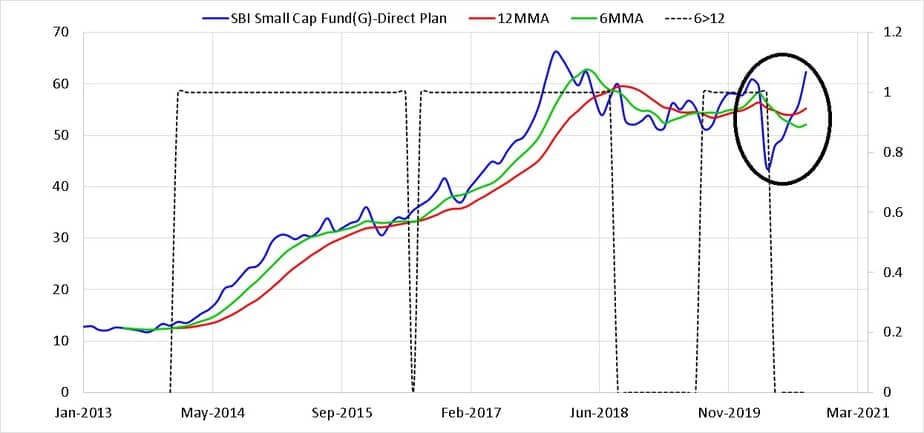
Notice that although the NAV is well above both averages, the 6MMA and 12 MMA have been crossing each other (whipsaw) for the last year or so. Also, notice that the NAV was above both averages when the dotted line was = 1 (buy signal).
Currently, the dotted line =0 or 6 MMA < 12 MMA which is a sell signal (see links above examples and explanation). Thus investors should expect a period of poor returns in the coming months. Which is not a great discovery considering the poor GDP growth numbers and difficulties faced by small businesses. SBI’s decision to stop lump sum does seem like a smart move.
Investors sitting on good profits after the recovery can consider booking profits to the extent they are comfortable if they agree that the coming months would be tough in the small cap space. If you are investing via SIP, then consider the benefits of tactical exits while continuing the SIP.
Critics of tactical asset allocation justifiably deride the arbitrary nature of choosing the monthly average tenure (6,12). However, their criticism is with respect to the hope of getting higher returns. This is true, tactical asset allocation should not be implemented with this hope. It is lower risk and in this case, stress.
The prospect of lower risk varies with change in moving average duration but does not vanish. Too low a duration for computing average then whipsaw increases and it is impractical to use. Too high a duration then all information is averaged out. Although there is no Goldilocks number, some number neither too high nor low would reasonably reduce risk.