Last Updated on October 8, 2023 at 1:39 pm
The incredulous 7% fall in the NAV of Taurus Liquid Fund due to a credit rating downgrade has many worried. Can investors avoid such funds? Is this a “small amc” problem? Is this a small aum problem? I thought liquid funds were safe! Just a sample of how many investors feel. In this post, I discuss these issues and how to minimise risk associated with liquid funds.
First, let us get the obvious out of the way. No mutual fund is safe. Risk cannot be avoided (without enhancing other types of risk) and can only be minimised.
Second, why should one use liquid mutual funds? Because the AMC or the fund sales guys tell you that money sitting idle in your SB account or fixed deposit is a crime? Because they say that you can get better returns in a liquid fund? Hogwash! If you fell for it, you’ve been had!
Third, what is the big idea of wanting to earn 1-2% more return from an emergency fund?!
🔥Secure your future with our Robo-advisory tool trusted by over 3,500 investors and advisors. From effortless retirement planning to funding your children’s biggest dreams, turn your financial goals into reality. 🔥
Subscribe for money management solutions via email! (Link takes you to our email sign-up form) Join 32,000+ readers in our community.
👉 New Tool Alert! NaviPlan: A Privacy-Focused Multi-asset Tracker and Goal Planner 👈
What is the use of a liquid fund?
Well, it is meant to earn “a bit more” than a savings bank account. At what cost? (1) the redemption is not instant and (2) the risks are much higher.
The typical liquid fund monthly return can vary by +/- 0.25%. You may think that this is “nothing”. However, it is the unknown risks that matter.
That +/- 0.25% is the market demand and supply variation. This is what we usually perceive on a day to day basis and this is what star rating agencies use as part of their star ratings.
The unknown risk exists everywhere. We do not expect our bank to collapse. Even if we think about it, it is reasonable to expect that a “well-established” bank is unlikely to collapse overnight. Of course, it can and has happened but we have to consider probability at some stage or forget about returns.
In the case of a debt fund, the unknown risk is the change in credit worthiness. Unknown in the sense, not well understood by many.
Let us imagine ourselves to be a money lender. We lend money to only known people. Their credit-worthiness demands a low-interest rate. Suppose we get greedy and lend to one untrustworthy person at a high rate.
We may think we have “diversified risk” by keeping untrustworthy borrowers low. But imagine the hurt to our cash flow if that person defaults on payments.
That is life. We have to take risks to make more. If we repeat the mistake, then we alone are to blame for the loss. As argued yesterday, I think Taurus made a similar mistake when they rolling over the tainted bond.
This is not a “small amc, trying to compete” problem. It has happened to ICICI and Franklin before. AUM size has little to do with this, except perhaps, the concentration of holdings. A fund with large aum tends to hold many securities with smaller portfolio weights. This could reduce the fall in case of a credit rating downgrade. But then again, what is big or small is quite subjective.
What can we do as investors?
We cannot control the behaviour of fund managers. So let us focus on what we can do.
Option 1: avoid debt mutual funds I am not a mutual fund salesman. So I present this option without batting an eyelid. Who says you need debt mutual funds? You don’t.
If you are unwilling, uninclined, unable, to appreciate risks or unlikely to understand them, stay away from debt mutual funds or any product for that matter.
As mentioned many times here, never invest by looking at star ratings or past performance. Invest only in what you can/wish to understand.
Read more: Do’s and Don’ts of Debt Mutual Fund Investing
Option 2: minimise risk. This means minimising returns too. Within the liquid fund category, you will find funds that dabble in lower than AAA bonds to varying degrees and funds that handle only cash (overnight or short-term collateralised borrowing or CBLOs). Choose the cash management funds. They will have 1/2 stars only, though! More on this later. This will not eliminate risks, but minimise them to a reasonable extent.
The other option is to eliminate credit risk, but embrace minimal interest rat risk by stick to very short term gilt (GOI) bonds. Read more here and here
Option 3: Take some risk but keep an eye. Risk = effort. So if you want to or if you are already using a liquid fund that invests in any kind of non-sovereign debt, then there is no option but to keep any eye on the portfolio once a month. If you are uncomfortable about the holdings, pull out.
I know that this is not a great option, but if a liquid fund can fall 7%, anything can happen. We cannot predict these, but at least can be mentally prepared better. I know, easier said!
The scheme information document is quite vague. Study the fund factsheets for random months in the last few years to check how the portfolio has changed. I prefer a fund that does not change investment style (even if that is risky)
Do not be scared: I know many investors who intelligently use debt mutual funds after retirement. It is not impossible. In fact, even if you do not have any need for debt funds now, it makes sense to learn more about them so that you can use them later.
What about my current liquid fund?
Please study the key information document (KIM) or Scheme information document (SID) to understand risk. Check past factsheets as mentioned above. Do this as a simple learning exercise without pressure.
Debt Mutual Fund Selection Guides
How and When To Select Ultra Short Term Debt Mutual Funds
Smart Ways to Invest in Corporate Fixed Deposits
How to Select Mutual Fund Fixed Maturity Plans (FMP)
Should I buy Long Term Gilt Mutual Funds?
How to choose debt mutual funds with no credit risk and low volatility
You Can Be Rich Too With Goal-Based Investing
My book with PV Subramanyam, You Can Be Rich Too With Goal-Based Investing is now available at a massive 31% discount of Rs. 276/- from amazon
What Readers Say:
Gift it to your Friends and Relatives whom you care more. Already follower of Pattu and Subra’s forum. Ordered 4 more copies to give gift to my friends and eagerly waiting to read
The best book ever on Financial Freedom Planning. Go get it now!
Your first investment should be buying this book
The (nine online) calculators are really awesome and will give you all possible insights
Thank you, readers, for your generous support and patronage.

Amazon Hardcover Rs. 276. 31% OFF
Kindle at Amazon.in (Rs. 244.30)
Google Play Store (Rs. 244.30)
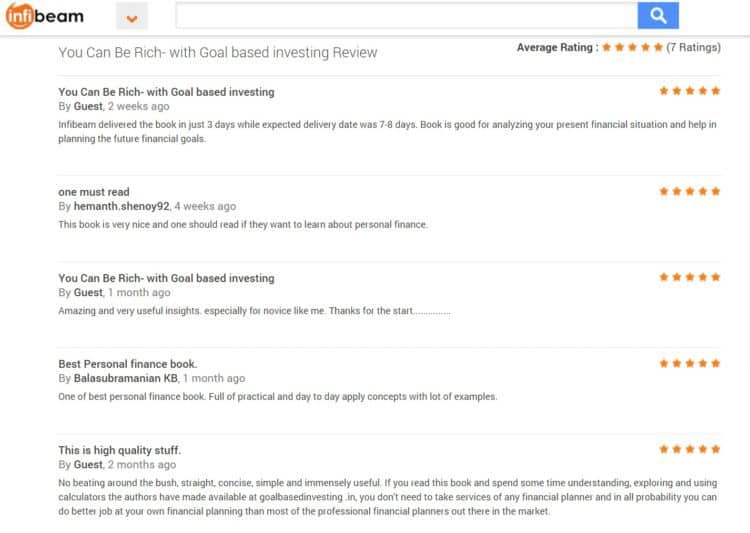
Infibeam Now just Rs. 307 use love10 to get additional 10% OFF.
If you use a mobikwik wallet, and purchase via infibeam, you can get up to 100% cashback!!
- Ask the right questions about money
- get simple solutions
- Define your goals clearly with worksheets
- Calculate the correct asset allocation for each goal.
- Find out how much insurance cover you need, and how much you need to invest with nine online calculator modules
- Learn to choose mutual funds qualitatively and quantitatively.
More information is available here: A Beginner’s Guide To Make Your Money Dreams Come True!
What Readers Say

Also Available At
Bookadda Rs. 371. Flipkart Rs. 359
Amazon.com ($ 3.70 or Rs. 267)
Google Play Store (Rs. 244.30)