Last Updated on October 8, 2023 at 1:39 pm
Why blame Value Research For awarding Taurus Liquid Fund that is in trouble for continuing to buy a near-junk bond (Ballarpur Industries), five stars (four stars when commissions are removed)? That is like blaming someone because they could not predict a market crash!
Before we go any further, it is important to recognise that many in the advisor community use star ratings. So there is no need to get holier than thou and start blaming “direct investors” here.
Update: Before we begin You Can be Rich Too is now 50% OFF as part of Amazons Best Reads March 2017 offer! Get it now!!
This is a perfect time to quote the opening monologue the movie about the 2008 crash, the big short.
🔥Secure your future with our Robo-advisory tool trusted by over 3,500 investors and advisors. From effortless retirement planning to funding your children’s biggest dreams, turn your financial goals into reality. 🔥
Subscribe for money management solutions via email! (Link takes you to our email sign-up form) Join 32,000+ readers in our community.
👉 New Tool Alert! NaviPlan: A Privacy-Focused Multi-asset Tracker and Goal Planner 👈
These outsiders saw the giant lie at the heart of the economy, and they saw it by doing something the rest of the suckers never thought to do: They looked.
I am sorry, but if people bothered to look at how star ratings are awarded and how categories are classified, they would have realised how flawed they are. There is no need to understand how they work.
The biggest flaw is not the fact that they use the same math responsible for the 2008 crash!
The biggest flaw is trying to group inherently/intrinsically distinct objects (funds) into a category and comparing one against another.
In April 2105, I wrote about How to Choose a Liquid Mutual Fund, and pointed out:
VR assumes that is okay to club a fund which holds short-term bond with a fund that holds only cash. It clubs together funds with different average credit quality and durations. I am not comfortable about that.
It is this clubbing that misleads an investor to assume blindly that a 5-star rated debt fund is better than others in terms of performance without recognising the notion of risk premium. Higher returns come from lower credit worthiness.
Yes, VR or any other star rating portal is wrong in clubbing different funds in the same category but is not smart to blame others for our mistakes. Who asked us to take those ratings seriously? If we see five stars and think that is a substitute for basic checks, who should be blamed?
Anyone who had bothered to scan the average maturities, investment style boxes and average credit quality, dug a little deeper into how these funds invest would have realised that these ratings are nonsense. Refusing to put in the effort and blaming others when things go south is not productive.
Excuse me but it is silly to assume these ratings are watertight and then crib when the balloon bursts.
You can find such flaws in every fund category. For example, value research thinks it is okay to club equity savings funds with equity-oriented balanced funds! At least in the case of credit rating downgrades, one can argue that the associated risk is not easy to model. In this case, the savings funds (arbitrage + debt) are nothing like (equity+ debt) in terms of risk as measured by daily ups and downs.
The other biggest flaw when it comes to star ratings is described here: The Blind Men and the Mutual Fund! and here Choosing a mutual fund is not the same as choosing a restaurant!
Enough talk about problems. Let us discuss solutions.
First, Value Research is not at fault to offer five stars to a fund before it suffered a credit downgrade. Its mistake was to club funds with different risk profile in the same category.
Second, the solution for investors has been discussed umpteen times here. Ignore star ratings and dig deeper. There is a fund for everyone.
(a) Investors who wish to avoid all credit risk and stick to govt bonds (gilts) can do so. There is a product for every duration in this space.
(b) Investors who wish to use funds that buy bonds tracking the overnight call rate (basically cash) can do so. More these later.
(c) If they want to funds that invest only in banks and PSU bond with predominantly AAA credit rating (which is not set in stone) can do so. Even if these bonds are downgraded the portfolio will not suffer too much and a default is not as probable. If you want returns, can’t hide from risk. Can’t hide from it anyway!
(d) If they want to take more risk and buy funds that dabble with bonds in the lower end of the rating scale, there are opportunities here.
All they have to do is to look and look beyond the star ratings.
The issue 1: The above-mentioned funds can be found in the same “category”.
The issue 2: A fund holding a risky bond will not show the effect of such holding until the credit rating is lowered as discussed before. In the case of Taurus, they continued to play the bond even after such a downgrade. Perhaps it is right, perhaps it wrong, but it is important to put such funds in a separate basket and then star rate them (if one must and can). This way the investors have an idea of what they are getting into.
If they realised that Taurus was working in such a shaky space, many may not have invested. This is the problem. Of course, a fund can rapidly change colour.
The solution:
1: have sub-categories to segregate investing style (not just with respect to Avg. maturity). If the no of funds in a sub-category is not high enough to provide a rating, don’t!
2: update changes in both average portfolio credit quality more frequently so that it is possible for a fund to move among the sub-categories more frequently.
3: Highlight the trend in a fund’s AUM prominently. It is common sense to avoid a fund whose AUM is dropping at a rapid clip regardless of its star rating. Thanks to Rajendra Dixit for pointing this out: Taurus Liquid Funds’ AUM dropped drastically from Jan 2016 to Jan 2017 (by ~ 50%).
As of now, I am not saying this is the reason for the Ballarpur debacle (will dig deeper), but if a fund holds a risky bond while its AUM is dropping, the concentration risk increases for the remaining investors.
4: News about bond rating downgrades should be fed into relevant fund pages.
Anything more?
You Can Be Rich Too With Goal-Based Investing
My book with PV Subramanyam, You Can Be Rich Too With Goal-Based Investing is now available at a 21% discount of Rs. 317/- from amazon
What Readers Say:
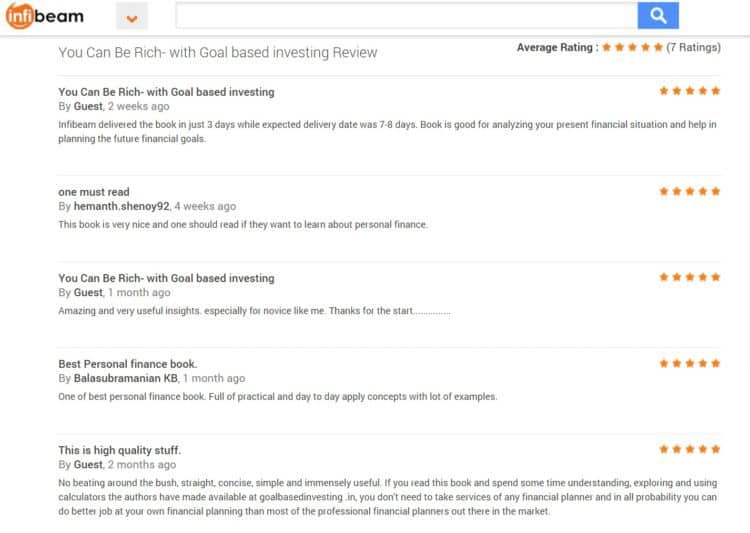
Gift it to your Friends and Relatives whom you care more. Already follower of Pattu and Subra’s forum. Ordered 4 more copies to give gift to my friends and eagerly waiting to read
The best book ever on Financial Freedom Planning. Go get it now!
Your first investment should be buying this book
The (nine online) calculators are really awesome and will give you all possible insights
Thank you, readers, for your generous support and patronage.

Amazon Hardcover Rs. 317. 21% OFF
Kindle at Amazon.in (Rs. 307)
Google Play Store (Rs. 244.30)
Infibeam Now just Rs. 307 use love10 to get additional 10% OFF.
If you use a mobikwik wallet, and purchase via infibeam, you can get up to 100% cashback!!
- Ask the right questions about money
- get simple solutions
- Define your goals clearly with worksheets
- Calculate the correct asset allocation for each goal.
- Find out how much insurance cover you need, and how much you need to invest with nine online calculator modules
- Learn to choose mutual funds qualitatively and quantitatively.
More information is available here: A Beginner’s Guide To Make Your Money Dreams Come True!
What Readers Say

Also Available At
Bookadda Rs. 371. Flipkart Rs. 359
Amazon.com ($ 3.70 or Rs. 267)
Google Play Store (Rs. 244.30)