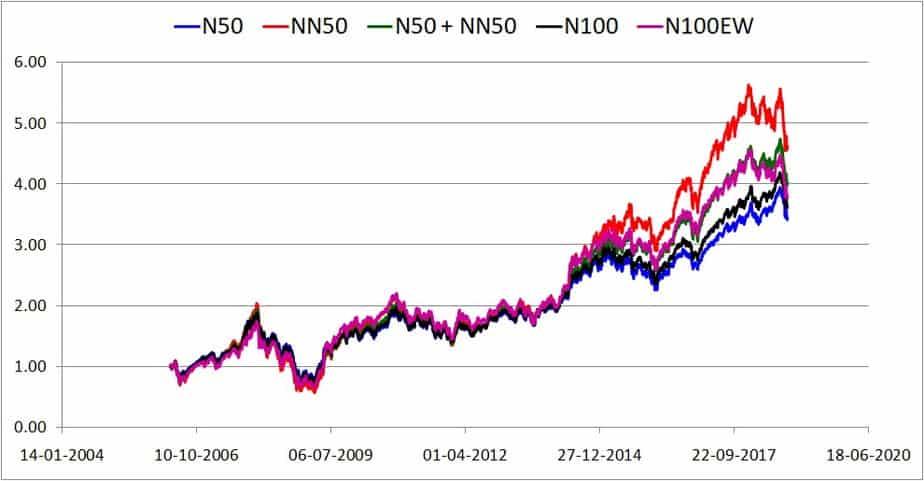
As readers may be aware, over the last few months I have presented evidence that the Nifty Next 50, Nifty 100 and Nifty 100 Equal Weight indices are hard to beat and only about half the funds in any given category manage to do so. However, the Nifty Next 50 is extremely volatile; there are no index funds tracking Nifty 100; the two funds tracking Nifty 100 Equal Weight of are low AUM. Therefore many readers have suggested or asked, Can I start Index investing with 50% Nifty 50 (N50) and 50% Nifty Next 50 (NN50) Index funds? Let us find out.
In particular, I would like to thank Sanjay Dixit who first suggested that I test this Nifty Blend (50% N50 +50% NN50) and Ravikiran Suryanarayana who posted on FB group Asan Ideas for Wealth that this blend has outperformed many active funds.
So let us look at this problem step by step. First, I compare Nifty 100 (N100) with Nifty 100 Equal Weight (N100EW). Then I compare the Nifty blend with N100 and N100EW. After that, we shall consider the results of a SIP in these indices from April 2006.
🔥Secure your future with our Robo-advisory tool trusted by over 3,500 investors and advisors. From effortless retirement planning to funding your children’s biggest dreams, turn your financial goals into reality. 🔥
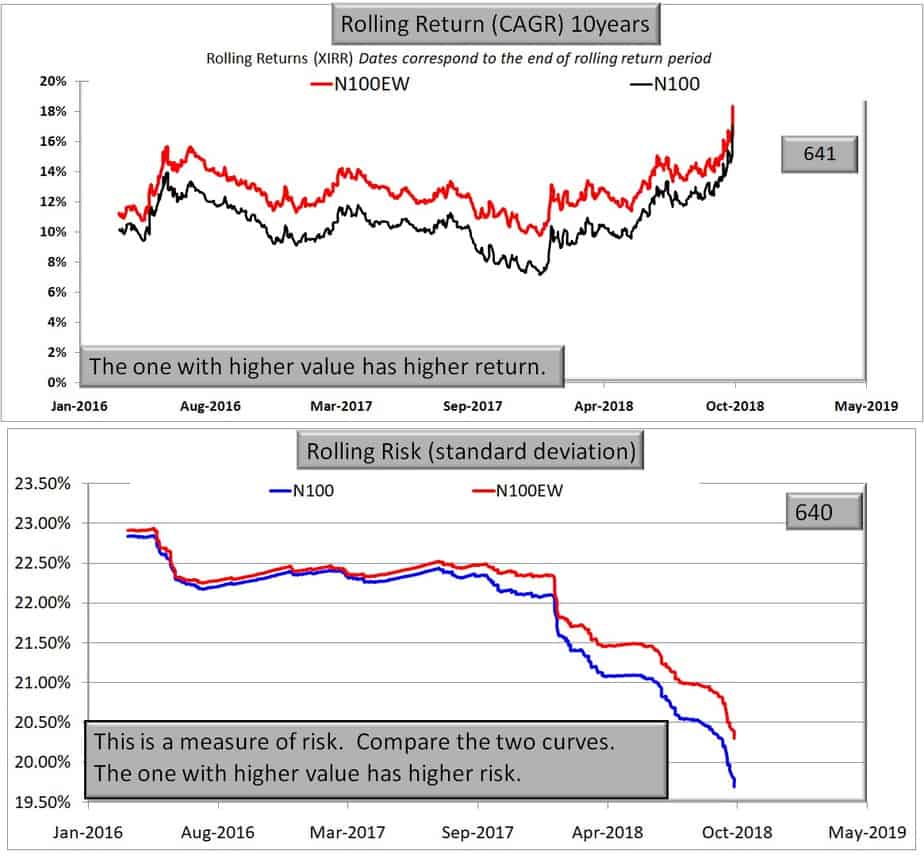
These are 614 10-year rolling return data points of each index compared and in the bottom panel, the rolling risk (standard deviation) is plotted.
Clearly, the N100EW offers a bit more risk with a bit more return, which is fine. The question now is, if I choose 50% N50 + 50% NN50, which index will I be emulating: N100 or N100EW?
50% Nifty 50 and 50% Nifty Next 50 vs Nifty 100
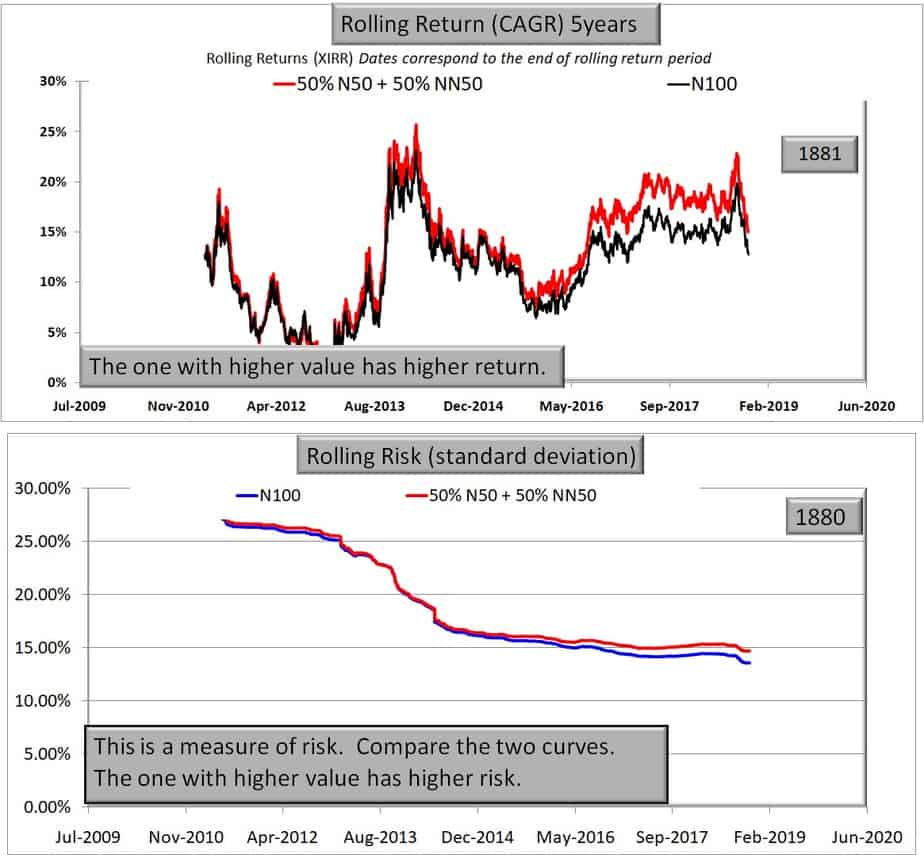
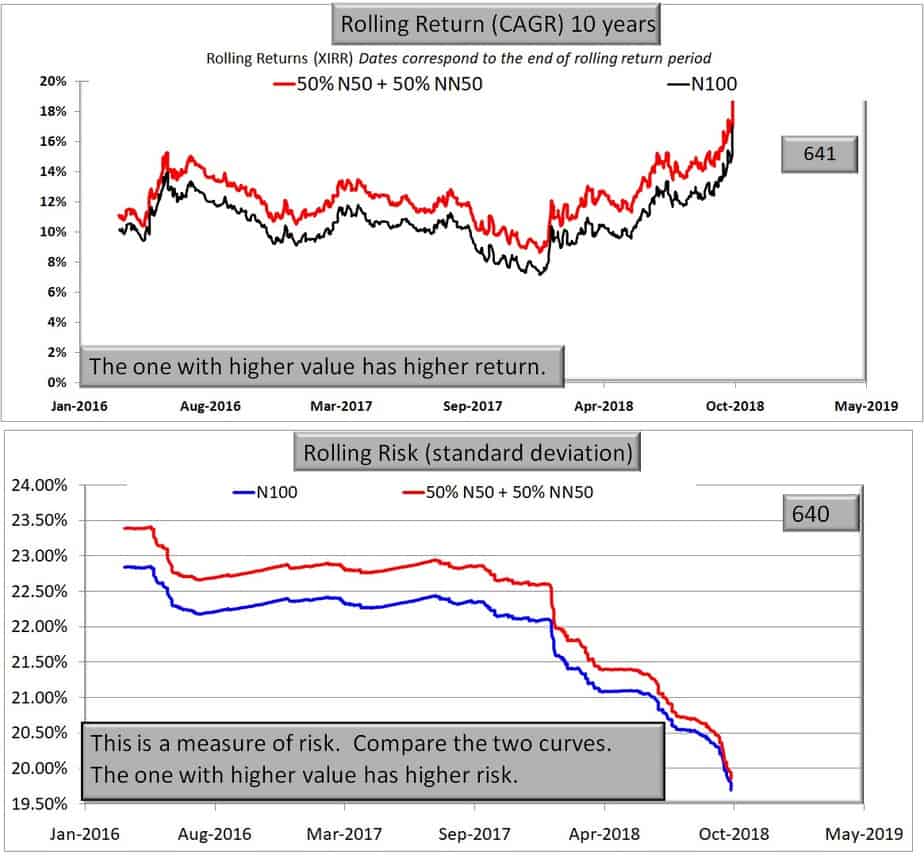
We shall now look at similar graphs as above for 5Y and 10Y.
Five years
Ten years
The Nifty blend is clear more rewarding but also a bit more volatile than N100.
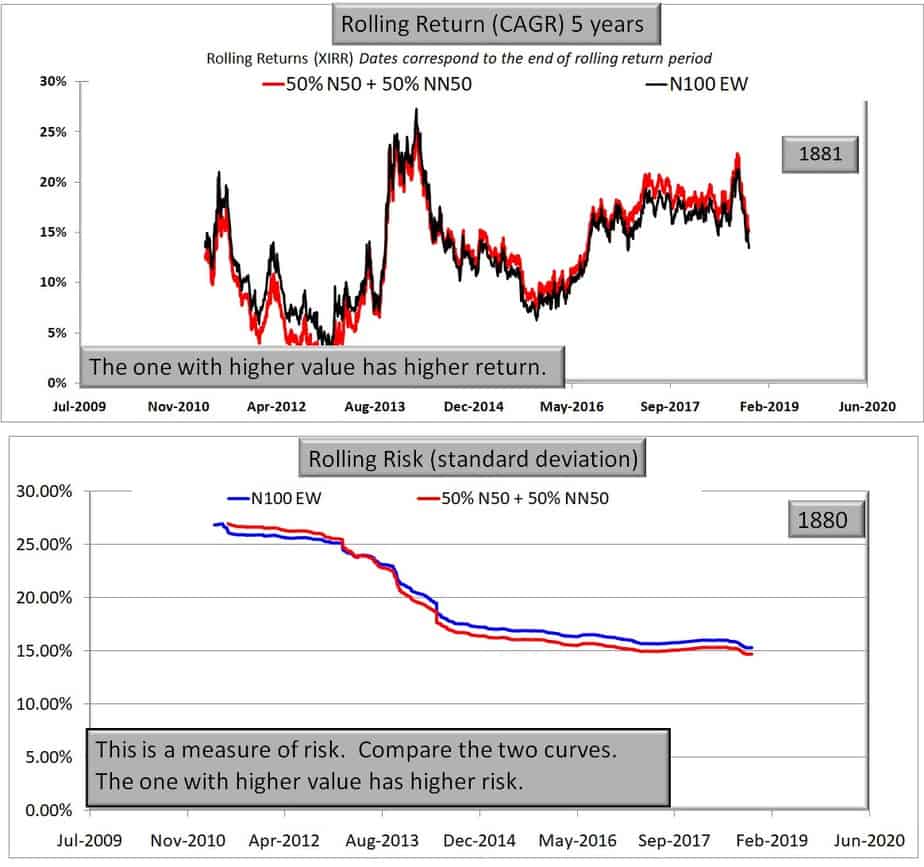
50% Nifty 50 and 50% Nifty Next 50 vs Nifty 100 Equal Weight
Five years
Ten years
I think 50% Nifty 50 and 50% Nifty Next 50 is a good proxy for Nifty 100 Equal Weight. The advantage with the blend is that you have your money split into two funds and this is psychologically a lot more comforting. Those who want less volatility can reduce NN50 exposure.
The 50% Nifty 50 and 50% Nifty Next 50 blend index analyzed above is based on a daily rebalanced index. This is a bit of an overkill as usually composite indices are rebalanced only monthly.
So we need to look at an actual investment and check if the blend will work. The simplest way is to consider SIP investments from April 3rd 2006 onwards: 146 months.
Index
XIRR
N50
10.33%
NN50
14.11%
N100
10.96%
N100EW
11.36%
Nifty blend index
12.29%
Nifty blend (weighted)
12.22%
Nifty blend (combined)
12.35%
Here:
Nifty blend index refers to the daily rebalanced composite index used in the rolling return analysis above
Nifty blend (weighted) refers to 50% return of N50 + 50% return of NN50 SIPs
Nifty blend (combined) refers to the combined XIRR of N50 and NN50 SIPs
The agreement among these three is fairly close. This reiterates the earlier observation that Nifty blend is a good proxy for N100EW and it has the potential to outperform N100.
This means that the outperformance results of N100 and N100EW published earlier automatically apply to the Nifty blend portfolio as well! See:
Rebalance the portfolio once a year. We now have enough evidence to suggest that both young and old investors can start index. Young investors can quickly start increasing exposure to these indices and older investors can do so more gradually.
If you don’t want to do so, then consider an aggressive hybrid or dynamic asset allocation funds where the higher expense ratio is justified. However, you will have to worry about fund manager risk.