Last Updated on April 5, 2016 at 5:35 pm
While recommending equity as an asset class or equity mutual funds as an instrument suitable for newbies, illustrations about the power of compounding, past returns and how they have comfortably beat inflation are typically used.
This is followed by caveats (besides past performance disclaimers) that the investor must
- be ready to stomach the ups and downs of the market,
- ride the course,
- stay invested no matter what,
- get used to volatility etc.
These caveats are typically not quantified. Even if done (as attempted here in the past), they do not help in preparing in the investor for the journey ahead as much as they should.
In the post, which I would like treat as the second part of Asset allocation for long-term goals, let us discuss about ‘what to expect’ when you invest in equity mutual funds.
🔥Secure your future with our Robo-advisory tool trusted by over 3,500 investors and advisors. From effortless retirement planning to funding your children’s biggest dreams, turn your financial goals into reality. 🔥
Subscribe for money management solutions via email! (Link takes you to our email sign-up form) Join 32,000+ readers in our community.
👉 New Tool Alert! NaviPlan: A Privacy-Focused Multi-asset Tracker and Goal Planner 👈
There are two aspects to investing in volatile securities:
1) ‘How’ to expect: For the investment period I have in mind, how much could returns vary? How can I quantify this?
This is of course based on backtesting. While the future is unknown, quantifying past volatility tells me that I should expect at least that much fluctuations in return in the future.
This was earlier covered for debt mutual funds:
Debt Mutual Fund Returns: How to expect when you are expecting!
and equity mutual funds in two parts*:
How much can I expect from equity as an asset class for long-term goals? Part 1
How much can I expect from equity as an asset class for long-term goals? Part 2
(*) link titles are different from post titles to avoid confusion.
2) ‘What’ to expect:
‘How to expect’ helps me conclude that for the investment period I have in mind, the return could be anything between: (R-X) to (R+X).
Where X is a suitable volatility measure (typically standard deviation).
However, it does not give me an idea of how much my portfolio will drop in value for a particular asset class or for a particular asset allocation.
Let us try and address this now.
We shall consider the same portfolio used in Asset allocation for long-term goals
Franklin Indian Blue Chip as representative of equity and Franklin Indian Income fund as representative as debt. These are among the oldest equity and debt funds in the market.
This is how the NAV movement for each fund looks like
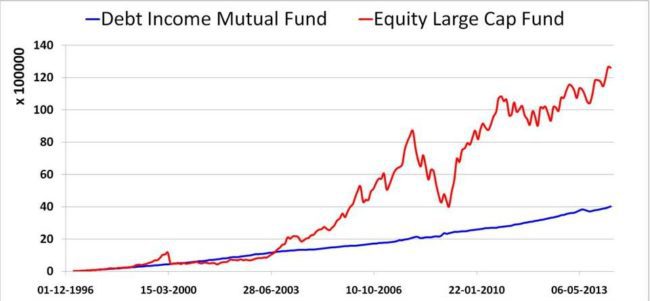
The data is from 5th March 1997 to 5th May 2014.
We will now calculate a metric known as maximum drawdown.
This simply refers to the maximum percentage fall from a peak for a given time period.
For the above mentioned period, a portfolio that has 100% equity would have experienced a maximum drawdown of 74.6%
How many young investors who claim to have ‘high risk appetite’ could have endured such a fall? Talk, like backtesting, is easy!
A 100% debt portfolio would have experienced a max. drawdown of only about 6%.
Now the max. drawdown for different asset allocations.
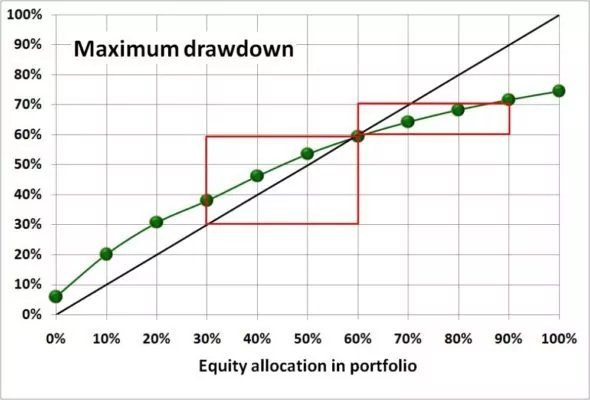
The black line is for reference. It is a y=x line.
Investors with 60% to 90% equity allocation suffered a max drawdown of 60-70%. I think it is not a bad idea at all to expect such a huge drawdown to occur at least once during the investment duration.
For 30% to 60% equity allocation, investors suffered a max drawdown a little more than their actual allocation.
That is, an investor with 40% equity allocation suffered a max drawdown of little more than 40%.
Portfolios with 10-30% equity allocation had surprisingly large max. drawdowns.
What is the point of this post?
1) If you have decent amounts of equity exposure for your long term goals (which you must), pay attention to this bit advice from the legendary Bette Davis (24 seconds video)
2) To be forewarned is to be forearmed. In this case, we go one step further and embrace the volatility and welcome a market crash. SIP investors will be able to buy more units automatically. Those who have been stashing cash can mobilize it.
A huge drawdown is a necessary evil.
No other asset class, not gold, not real estate, not fixed income, offers you such wonderful opportunities to profit from, every few years.
Here’s hoping we make the most of it.