Last Updated on February 12, 2022 at 6:13 pm
As I opened my investment tracker spreadsheet for this month, I realised that I have been at it for the last ten years. This is how tracking investments have changed my life and why I strongly recommend it.
Today I can invest more for retirement than my target investment. That was not the case when I started. In 2011 I noticed I was consistently investing less than the target. Several months in 2013, 14, 15, I could not invest due to higher expenses and struggled to make up for it.
By target, I refer to the output of a thorough retirement planning calculation. If you are wondering, “why did he stop investing due to higher expenses? Why did he not use an emergency fund?” ask yourself, “how will you refill a depleted emergency fund?”, “How will you handle an unexpected recurring expense?”
The number 1 benefit of tracking of investments: You are aware of your future goals, you appreciate how much you need to invest for them, and whether or not you can invest that much, you have a target. Knowing where you stand is the first to appreciate how far you need to travel if you need some inspiration to get started, check the personal financial audits from our community linked at the end of the article.
🔥Secure your future with our Robo-advisory tool trusted by over 3,500 investors and advisors. From effortless retirement planning to funding your children’s biggest dreams, turn your financial goals into reality. 🔥
Subscribe for money management solutions via email! (Link takes you to our email sign-up form) Join 32,000+ readers in our community.
👉 New Tool Alert! NaviPlan: A Privacy-Focused Multi-asset Tracker and Goal Planner 👈
Number 2: I have been listening and re-listening to the excellent money management classic The Richest Man in Babylon, and each time I learn something new, I find a new article idea. One of the earliest known mentions of “pay yourself first”. When we track investments, we get a sense of accomplishment – that is, we find some balance between current expenses and future expenses (the reason we invest).
Number 3: When you pay yourself first (if you can), tracking expenses become unnecessary (IMO) and essentially an academic exercise. Budgeting is essential when money is tight and you struggle to make ends meet. Once you can regularly find a surplus – which is when paying ourselves first is possible – budgeting is unnecessary. We invest first and spend the rest.
For someone less than 30 reading this, I would urge you to do everything possible to get to this position first – where you can invest some amount (any amount) regularly. This is the first step to building wealth.
The next step is to try and increase the amount we can invest by as much as possible every year. For this, our income should increase, but our expenses should not grow at the same rate! Again quoting the richest man in Babylon – increase thy income!
If you believe your income is low and you do not see it increasing too much in future, then do everything possible to learn new skills or have a side hustle to increase your income.
Children with financially secure parents should be told to qualify themselves as much as possible and become professionals or entrepreneurs instead of run-of-the-mill salaried guys in their early 20s. There will be a long struggle, and you will not be able to invest anything in your 20s or even up to your mid-30s, but you can easily catch up later with essential money management commonsense and higher salaries.
The results of a retirement calculator would always look impossible to achieve (otherwise, there is something wrong with the computation!). See, for example, We lost sleep after using a retirement calculator! This is how we recovered. However, we must have the hope, perhaps even a vision, that we will earn more and invest more in the future.
The trick to succeeding with anything in life is to work consistently without expectations and without any sign of an obvious reward for our efforts. Investing systematically is a simple example of this activity. Tracking investments helps you stay on course. It reminds you of the progress you have made or reminds you (painfully) of the distance that you need to cover. Ten years of this diligent exercise has taken me to financial freedom: How my retirement portfolio has performed in 2020: personal finance audit.
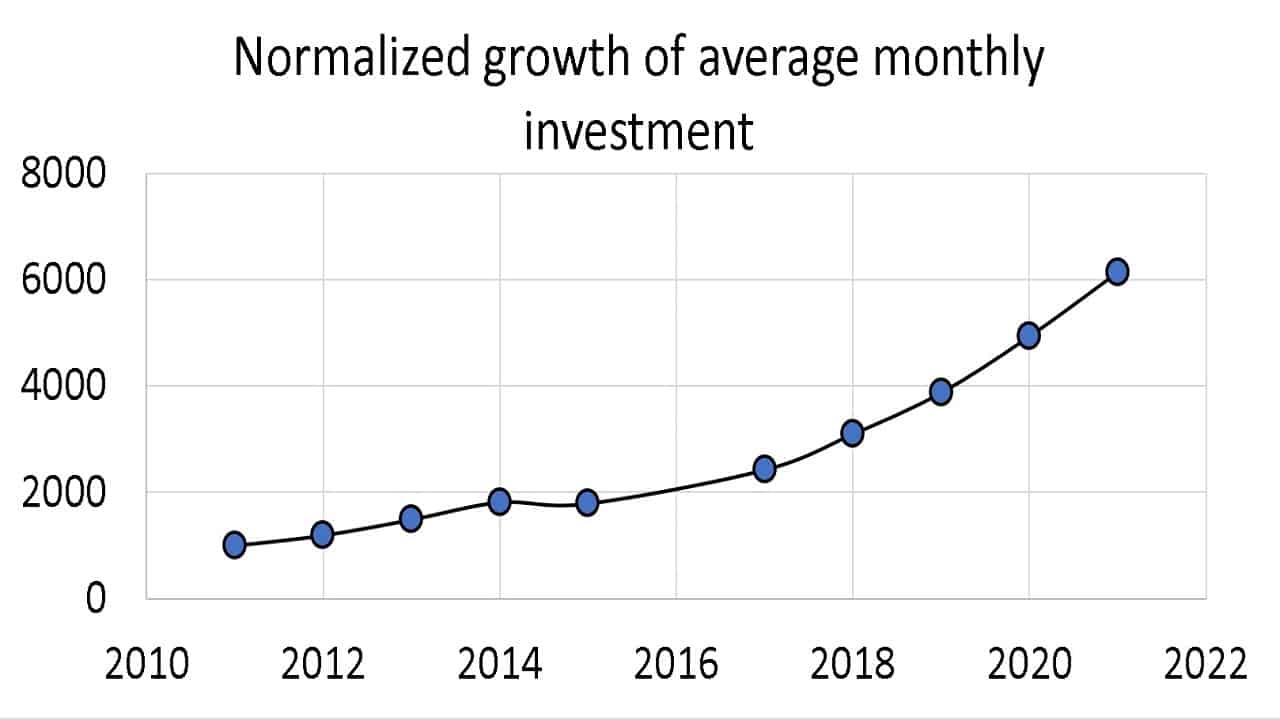
This is the average rate of increase in monthly investments for retirement. I lost the 2016 data due to a hard drive crash. I started investing in mutual funds in a small way from June 2008, but it is only from 2010/11 that I started proper goal-based investing.
| Year | Average Rate of increase in monthly investments |
| 2021 | 24% |
| 2020 | 27% |
| 2019 | 25% |
| 2018 | 28% |
| 2017 | 35% |
| 2015 | -1% |
| 2014 | 22% |
| 2013 | 25% |
| 2012 | 19% |
I would recommend maintaining a 10% increase in investments each year or 70-100% of your monthly expenses. This will get tougher with time, but try we must. For early financial independence aspirants, investing 2-3 times, monthly expenses would be necessary.
In my case, it is a sheer providence that I have been able to achieve an investing CAGR of about 20% consistently (rate of increase in investments each year). My investment CAGR (18.3% from June 2008 to July 2021) is less than my investing CAGR 🙂 and fluctuates a lot more! This is a fair outcome as I have tracked my investments more often than I have tracked their value.
The growth in normalised average monthly investment made is shown below. If I invested Rs. 1000 in 2011, I am now investing about six times more.
Tracking investments each month for each goal has the same benefits as tracking our exercise regiment with an app or watch. It gives you a sense of control over the controllable and lowers your fear of the future.
Many youngsters assume paying ourselves first would be depriving ourselves of the pleasures of life. This is not true. The sole purpose of money in our lives is to get spent for our benefit. Investing is a way to ensure we can continue to spend in future happily. So we need to find some balance between spending today and developing an ability to spend in the same way tomorrow. How we find this balance is personal and up to the individual.
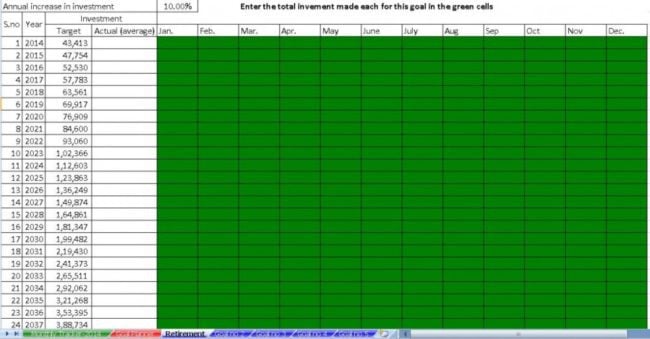
This is the template I used to track investments: Download the monthly financial tracker.
Need some inspiration to get started?
Check out personal financial audits from readers.
- First audit: How Suhas tracks his MF investments and reviews financial goals.
- Second audit: How Avadhoot Joshi evaluates his investment portfolio.
- Third audit: How a single mom is on track to financial freedom
- Fourth audit: How Gowtham started goal-based investing & took control of his money
- Fifth audit: Why my financial independence & early retirement plans were postponed by four years
- Sixth audit: How Abhisek funded his marriage & is on track to financial freedom.
- Seventh audit: How Rohit’s early struggles defined his investment journey
- Eighth audit: Why my investments are still on track despite job loss and lower-income
- Ninth audit: How a retirement planning calculation scared me to take action
- Tenth audit: I made several investment mistakes but have turned my life around.
- Eleventh audit: My net worth doubled in the last financial year thanks to patient investing!