In April 2022, we met Arka and Rupali, who are trying to balance their aspirations, like travelling and exploring new opportunities, with their quest for financial independence. They followed it up with a sequel in May 2023. This is part 3.
About this series: I am grateful to readers for sharing intimate details about their financial lives for the benefit of readers. Some of the previous editions are linked at the bottom of this article. You can also access the full reader story archive.
Opinions published in reader stories need not represent the views of freefincal or its editors. We must appreciate multiple solutions to the money management puzzle and empathise with diverse views. Articles are typically not checked for grammar unless necessary to convey the right meaning and preserve the tone and emotions of the writers.
If you would like to contribute to the DIY community in this manner, send your audits to freefincal AT Gmail dot com. They can be published anonymously if you so desire.
Please note: We welcome such articles from young earners who have just started investing. See, for example, this piece by a 29-year-old: How I track financial goals without worrying about returns. We have also started a new “mutual fund success stories” series. This is the first edition: How mutual funds helped me reach financial independence. Now, over to the reader.
🔥Secure your future with our Robo-advisory tool trusted by over 3,500 investors and advisors. From effortless retirement planning to funding your children’s biggest dreams, turn your financial goals into reality. 🔥
Subscribe for money management solutions via email! (Link takes you to our email sign-up form) Join 32,000+ readers in our community.
👉 New Tool Alert! NaviPlan: A Privacy-Focused Multi-asset Tracker and Goal Planner 👈
Here, we are back with our third yearly audit (first and second) of our financial health. A huge thanks to numerous yearly audits posted on freefincal – we were also motivated to document ours at least once a year. And thankfully, we are doing this for the third year in a row.
Before we begin, a very brief background about us – I (Arka) and my wife (Rupali) got married in 2020 (just before the pandemic) – I am currently 36, and we started our financial planning seriously only after our marriage, which is in 2020. I work in an IT Consulting firm, and Rupali is in Tax Consulting. We have surely started late, but we are trying to ramp up the investments to cover it while managing our huge love for travel. Now, let’s dive in.
Basics: First, let’s review our basics as of March 2024.
Emergency Cash: 5 months of current mandatory expenses (when both of us stopped earning) and not to be touched upon (in case the higher earning person stopped earning).
The runway in the scenario of “both of us stopped working” increased one year, the same as last year. But due to finishing the Education loan, the scenario of “only higher-earning person stopped earning” has now covered the mandatory monthly expenses
Health Insurance:
- 10L base + 50L Super Top Up (Self and Wife)
- 10L base + 15L Super Top-up (Parents)
Both are taken outside office health insurance, and parents are not added to office health insurance.
Term Plan
- Six years of current annual income (self)
- Five years of current annual income (wife)
Income distribution: Below is the monthly distribution in different buckets of investments and expenses as a percentage of monthly earnings and how it has changed over the years.

Key observations compared to last year
- Certain buckets percentage has decreased because of increase in earnings compared to last year while the expenses for that bucket remained same
- Insurance premium includes term and medical insurance (both us and parents)
- The extra earning is primarily channelled for investments and travel. Also due to the closure of education loans, the percentage exposure to investments has increased.
- Travel is one of our primary expense buckets, as both of us like to travel, hence keep a significant amount to fulfill our travel dreams. To compensate that, we minimize discretionary spending like shopping and eating outs throughout the year and consider this travel corpus as our extended emergency bucket. We document our travel in our website and YouTube channel. Would love it if you have a look. Last year we visited two of major bucketlist places – the Galapagos Islands & Amazon Rainforest. You can read our experience on our website: Galapagos Islands from India: all you need to know.
- As parents get older, we have noticed that not all medical expenses will always be covered by the insurance. Hence, I started a bucket for Medical Expense savings. I am contributing a small amount to this bucket and will continue until it reaches the base health insurance policy amount (a long road to go !!). Currently, it is around 12% of base health coverage.
Goals:
- Retirement Goal (Considering another 19 years away). We don’t mind working till mid-50s (if possible). However, we will try to achieve financial independence (FI) before that. As of now, the target is to reach 35 years of expense as corpus
- Buying a house – Here, things have changed from last year. Due to Education loan closure, we started keeping 25% of the total investment every month in Arbitrage fund. This may not completely suffice if we want to purchase in 5-7 years horizon – but the idea is to minimize the loan amount.
- We don’t have any kids and will plan as and when the situation changes.
Investments: Before planning in April 2020, the majority was in PF, and some small components were in PPF and ELSS. The idea was first to build an emergency fund and then maximise equity investments for retirement as a goal.
- For emergency funds, 60% is in savings accounts (including FD), and 40% is in the ICICI – Arbitrage fund direct plan.
- For retirement, asset allocation is as follows.
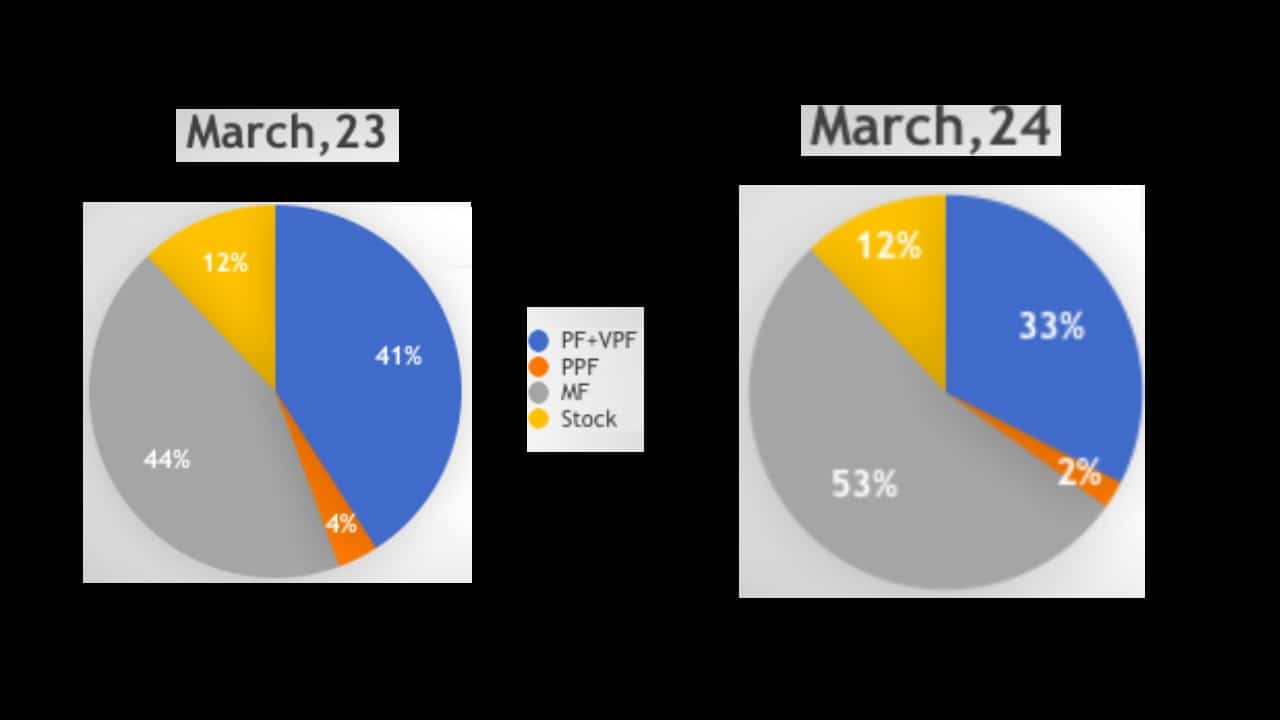
The aggressive investment in equity has increased the equity percentage from 56% in March 2023 to 65% in March 2024. This is a significant leap, as when we started in April 2020, equity was only in ELSS and for about 12% of the total corpus. The plan now is to maintain around 65% for another four years and trigger a rebalance with a 5% deviation on either side.
The portfolio composition of mutual funds (53% of the retirement corpus) and direct equity (12% of the retirement corpus) as of March 2024 is shown below.
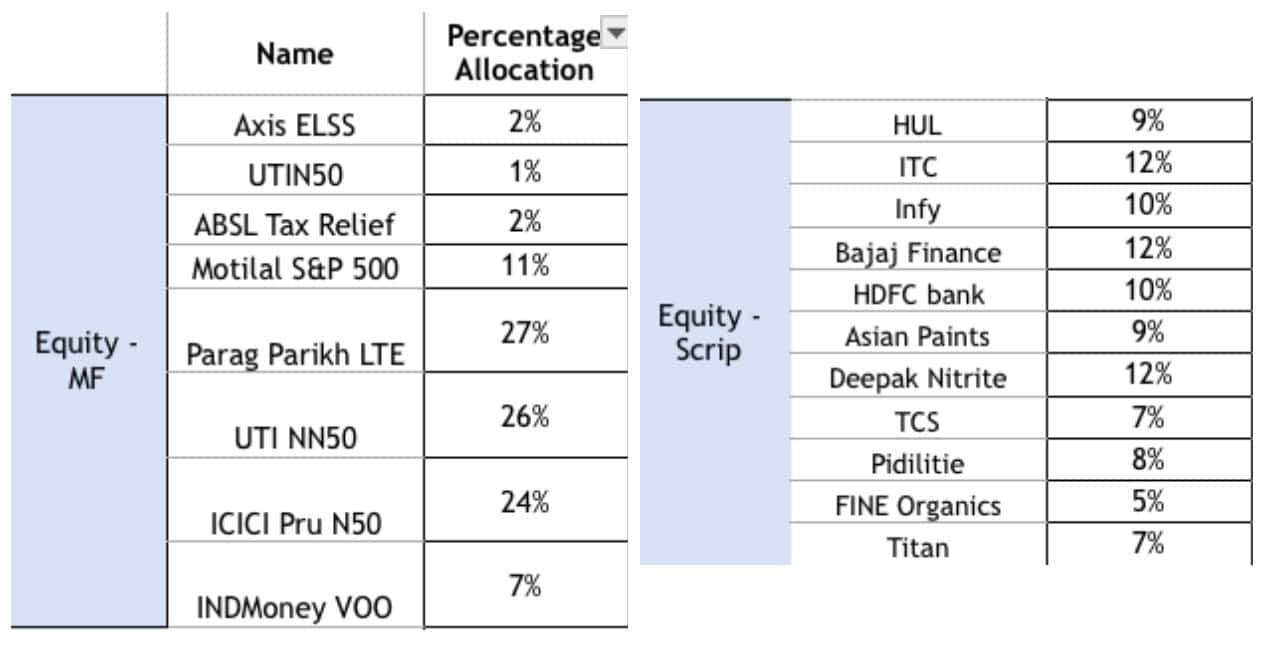
The plan is to consolidate the first 3 MF investments into the last five MFs. Direct Equity investment has not performed well this year. Hence, the percentage of the overall corpus remains the same. The expectation from direct equity is to create a stable source of dividend income over the years. Currently, dividends are getting reinvested.
Performance:
- The retirement corpus is the first and most important parameter of the performance. As of March 2021, it was at a little less than one year’s current expense (accumulated value of all previous year’s investments). As of March 2022, this value was close to 2 years. As of March 2023, this value just crossed the 3-year mark and as of March 2024, it is close to 5.5 years.
- Below is the XIRR for equity MFs. Since ELSSs were invested before the pandemic and stopped after August 2020, the XIRRs are high. Still, the weightage of the ELSS in the overall portfolio is significantly less, as mentioned above. The stock portfolio is at an XIRR of 10.61%
- Axis ELSS 15.23%
- UTIN50 21.32%
- ABSL Tax Relief 12.28%
- Motilal S&P 500 19.62%
- Parag Parikh LTE 26.07%
- UTI NN50 28.69%
- ICICI Pru N50 17.89%
- INDMoney VOO 6.09%
- Overall MF CAGR 22.04%
Plan for 2024-25:
- There is only one financial goal: to invest as much as possible through Equity in the retirement fund. We will revisit the asset allocation after six months and evaluate the need for rebalancing.
- From a personal goals perspective, I have set up quite a few at the start of this year and tracking their progress at the end of each month. Below is the illustration (the actual numbers are masked)
- X number of days of gym/10000 steps per day in the whole year
- X number of blogs and videos on our travel website and YouTube channel
- Learn a local language
- Not more than X number of days of eating out
I want to thank Pattu sir for the opportunity and the amazing FB group of Asan Ideas For Wealth, which is my one-stop solution for finance and career-related things. It has been immensely fulfilling, even for a passive member like me, just by reading posts, comments, and analyses. I wish this group grows bigger and wiser !!
Reader stories published earlier:
As regular readers may know, we publish a personal financial audit each December – this is the 2022 edition: Portfolio Audit 2022: The Annual Review of My Goal-based Investments. We asked regular readers to share how they review their investments and track financial goals.
- First audit: How Suhas tracks his MF investments and reviews financial goals.
- Second audit: How Avadhoot Joshi evaluates his investment portfolio.
- Third audit: How a single mom is on track to financial freedom
- Fourth audit: How Gowtham started goal-based investing & took control of his money
- Fifth audit: Why my financial independence & early retirement plans were postponed by four years
- Sixth audit: How Abhisek funded his marriage & is on track to financial freedom.
- Seventh audit: How Rohit’s early struggles defined his investment journey
- Eighth audit: Why my investments are still on track despite job loss and lower income.
- Ninth audit: How a retirement planning calculation scared me to take action
- Tenth audit: I made several investment mistakes but have turned my life around.
- Eleventh audit: My net worth doubled in the last financial year, thanks to patient investing!
- Update: How I achieved investing nirvana.
- Twelveth audit: My financial journey: from novice to goal-based investor.
- Thirteenth audit: My journey: from a negative net worth to goal-based investing.
- Fourteenth audit: From Fixed Deposits to Goal-based investing in MFs.
- Fifteenth audit: My 10-year financial journey – mistakes made and lessons learnt.
- Sixteenth audit (part 1): How I achieved financial independence without mutual funds or stocks.
- Sixteenth audit (part 2): Lessons from my financial independence journey and future investment plans.
- Seventeenth audit: How I plan to achieve financial independence and move to my native place
- Eighteenth audit: I used the current bull run to reduce my mutual funds from 14 to 4!
- Nineteenth audit: How a conservative investor created his financial plan
- Twentieth audit: I plan to achieve financial independence by 46; this is my master plan
- Twenty-first audit: I have made many investment mistakes but am on course to financial independence by 45.
- Twenty-second audit: I felt worthless six years ago but have achieved financial stability today
- Twenty-third audit: My financial journey was directionless until age 40: this is how I made up for lost time
- Twenty-fourth audit: Why I increased equity MF investments by 275% and reduced PPF contributions.
- Twenty-fifth audit: How I track financial goals without worrying about returns
- Twenty-sixth audit: I am 24 and started investing 1Y ago, but what am I investing for?
- Twenty-seventh audit: How we plan to achieve a retirement corpus 50 times our annual expenses.
- Twenty-eighth audit: I thought equity investing was a gamble, but now I aim to hold 60% equity for retirement
- Twenty-ninth audit: My journey: From 5 lakhs in debt to building a corpus worth six years in retirement
- Thirtieth audit: My investment journey: From random purchases to a goal-based portfolio
- Thirty-first audit: My investment journey: from product-driven to process-driven
- Thirty-second audit: How a young couple is trying to balance travelling and investing
- Thirty-third audit: My journey: From Rs. 30 bank balance to financial independence
- Thirty-fourth audit: Our journey: From scratch to a net worth of 18 times annual expenses.
- Thirty-fifth audit: From a net worth of Rs. 6000 to auto-pilot goal-based investing
- Thirty-sixth audit: How I retired from corporate bondage at 46, two years ago!
- Thirty-seventh audit: How I learnt to keep it simple and build a net worth 19 times my annual expenses
- Thirty-eighth audit: How Abhineeth plans to achieve financial independence and build a house.
- Thirty-ninth audit: How Sahil plans to achieve financial independence by efficient tracking
- Fortieth audit: My Journey to a Ten Crore Portfolio
- Forty-first audit: Burdened with debt for several years, I am now aggressively investing in equity
- Forty-second audit: From Engineer to Librarian after Financial Independence and Early Retirement (FIRE)
- Forty-third audit: I lost six months’ income in F&O and ditched it for systematic investing
- Forty-fourth audit: My retirement plan to handle the harsh realities of the IT industry
- Forty-fifth audit: My investment journey: mistakes, 10 years of MF investing and recovery
- Forty-sixth audit: My MF portfolio is worth six crores despite multiple mistakes
- Forty-seventh audit: Saving, Investing, and Running Marathons: My 25-year Journey to Financial Independence
- Forty-eighth audit: Never Too Late to Start: How I Became Financially Savvy at 40
- Forty-ninth audit: My Investment Journey to a net worth 29 times my annual expenses
- Fiftieth audit: How I audit my portfolio without tracking returns
- Fifty-first audit: Financial Lessons Learned During and After a PhD
These published audits have had a compounding effect on readers. If you would like to contribute to the DIY community in this manner, send your audits to freefincal AT Gmail. They could be published anonymously if you so desire.