In this edition of the reader story, Sanjoy shares how he found his way in money management.
Sanjoy’s earlier contributions:
- Financial Lessons Learned During and After a PhD
- The Road to Redemption: How I Overcame My Investment Mistakes
- Dealing with my investment fears and doubts
Opinions expressed in reader stories do not necessarily represent the views of freefincal or its editors. We must appreciate multiple solutions to the money management puzzle and empathise with diverse views. Articles are typically not checked for grammar unless it is necessary to convey the right meaning and preserve the tone and emotions of the writers.
If you would like to contribute to the DIY community in this manner, send your audits to freefincal AT Gmail dot com. You can publish them anonymously if you wish.
Please note: We welcome such articles from young earners who have just started investing. See, for example, this piece by a 29-year-old: How I track financial goals without worrying about returns. We also have a “mutual fund success stories” series. See, for example, how mutual funds helped me achieve financial independence. Now, over to the reader.
🔥Secure your future with our Robo-advisory tool trusted by over 3,500 investors and advisors. From effortless retirement planning to funding your children’s biggest dreams, turn your financial goals into reality. 🔥
Subscribe for money management solutions via email! (Link takes you to our email sign-up form) Join 32,000+ readers in our community.
👉 New Tool Alert! NaviPlan: A Privacy-Focused Multi-asset Tracker and Goal Planner 👈
I am very new to investing. Since 2021, I have had a demat account or SOA account, but it has felt like a very long journey in my mind. One good thing I have learned to do in this short period is to go back in time and delve into old records of videos, news articles, and research reports, leaving me with a permanent doubt about everything, as all were either absolutely wrong for the right reasons or absolutely right for the wrong reasons. So with this understanding of everything that can go wrong, I have found my nature and what I can or can’t do. I have understood that I can’t be on this journey with others’ conviction, I am completely on my own, and I am willing to live with the outcome. I don’t want to beat the index or be the index; I am my own comfort style, which might look highly risky or stupid to others, and that’s okay.
Section 1: Insurance. I have basic term insurance. The health insurance for me and my dependents is covered by my employer (PSU), for which I am extremely grateful. I haven’t taken outside insurance because my employer’s insurance is far superior to any private option, and matching it externally would result in a very high premium, which doesn’t make sense to me. Anyhow, I am willing to explore it, and I know I need to change my current inertia.
Section 2: Emergency Fund. My emergency fund is 5% of my net worth. However, I have made it the experimental ground for my family. As the breadwinner in the family, I can manage funds for emergencies if anyone else needs them, but what if I am in distress and my family needs to access funds? The family’s investment sceptics have been trained on Conservative Hybrid Funds for over 3 years, with me getting occasional blasts for even a few thousand rupee drawdowns on days. I know they are not yet ready for drawdowns in lakhs. I didn’t keep in pure liquid funds or ultrashort bond funds because they’re likely to be held for longer horizons without disturbance.
Section 3: Borrowings. None except the monthly cycle of credit cards (< 3% Utilization). Although I have been displaced 3 times in the last 3 years because of various Bengaluru reasons, I still didn’t think it was a problem worth a few crores (cost of a decent apartment in Bengaluru) and my family have been very supportive in this sense (because in Kolkata, that money would bring you a Bungalow). I may buy an apartment in the future, but not in this FOMO era or stress, rather in comfort in future if possible.
Section 4: Locked Instruments. I am not a fan of locked instruments, but I force myself to do it; my nature would force me to invest 100% in equities. Locked instruments include employer-given EPF and NPS Tier-1 contributions, as well as self-managed NPS Tier-2 and PPF accounts. I do contribute additional VPF in my EPF, just not to touch the tax liability on interest limit, but I do not make any additional contribution to NPS Tier-1. I find NPS Tier-2 to be an excellent place to use as a Corporate Debt Fund (Tier-2 C). Although not locked, I used NPS Tier-2 as an MF, which I do not redeem, and only a one-sided deposit traffic has been maintained. Unlike advised, I also make a full contribution to PPF by the 5th of April, and it has turned April Fool’s Day into a positive surprise over the last 4 years, as the interest is credited.
Section 5: Liquid Instruments / Stocks. I maintain two savings accounts, one for all incoming and one for all outgoing. It really helps balance the act. I do not keep much in my savings account, as it only enables me to spend more in my previous experiences.
Regarding equities (stocks), I have 0 in MFs. All my holdings are individual stocks, which are very risky and not recommended for anyone. However, having a 2.5-hour daily bus commute has really given me ample time to learn over the past few years. I am very comfortable in individual securities, and being a penny pincher in fallen stocks has become my interest. I don’t think my record is long enough to justify it, but I don’t intend to justify my actions. Maybe 10 years in the future I will re-evaluate myself and my story will be worth telling or an example of failure, but I am ready to accept and live with that outcome.
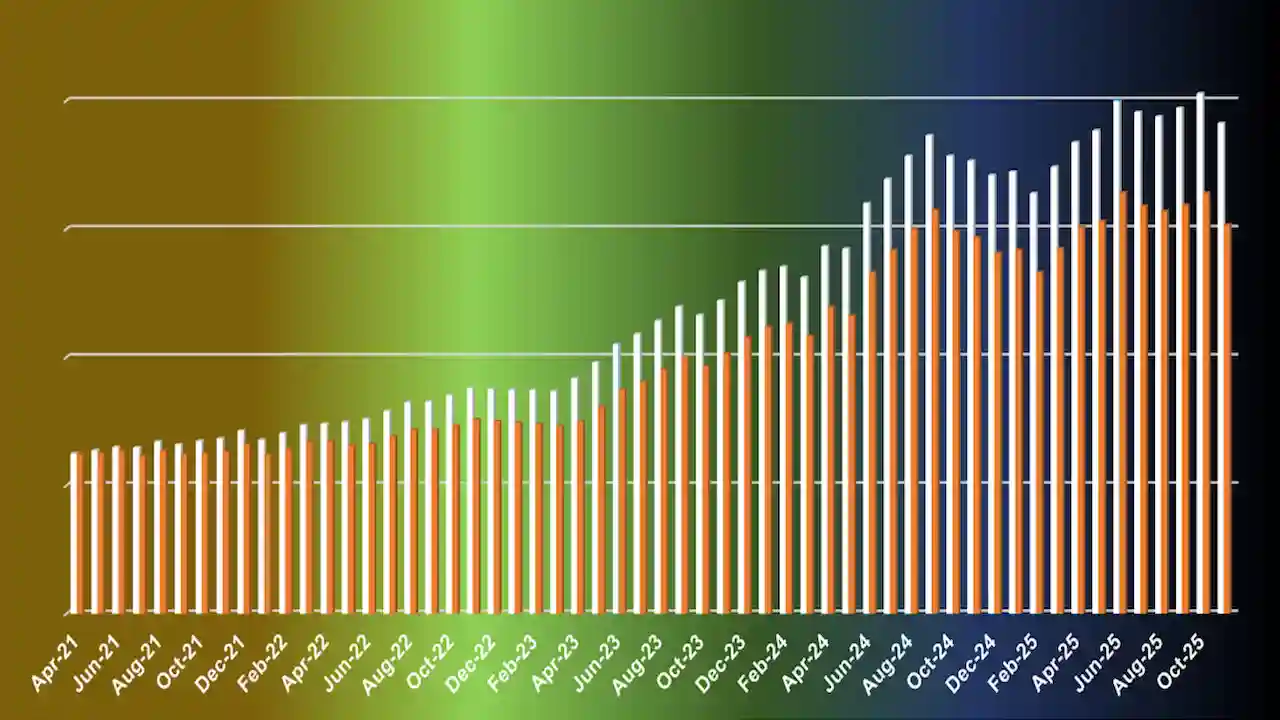
Figure 1 – Overall net worth evolution since having a job (white bars). The orange bars depict the liquid portions (dominated by stocks). The y-axis is an arbitrary unit as NW is not disclosed.
Overall trend.
- A positive “sequence of returns” of 2023-2024 have helped in jumping ahead.
- The absolute realization of the above’s non-repeatability and unsustainability was very important. Converting paper profits to realization, clearing taxes, and keeping what is left for myself in forgotten and relatively secured places was a work in progress.
- All current assets are net of taxes paid, as they are relatively newly re-invested in individual securities, unrealized P&L is near zero. Thus, if all amounts are withdrawn, the same amount will be available.
- First milestone / Relief – The first step of accumulating 30 years of expenses is achieved by age 37. However, to create absolute certainty of success, the goal is moved to achieving the current expenses equivalent only in fixed income instruments (say 40% of net worth), which will be possible only after another 2.5x journey or accumulating 75 years of expenses.
- Second milestone / Snowball effect – The second step of investment returns crossing in-hand decent salary has been possible in the last two consecutive years. At this stage, managing the corpus becomes a greater deal than additional contributions.
- Third milestone / Doing nothing – As Pattu sir mentioned, I also always wondered of growing up and doing nothing (just imagining things in my mind). I am taking the steps towards fewer decisions and longer ingestion periods.
- Changing the milestones – As the portfolio evolves, the mind also does. Finally, a peaceful investment is the best way of investing for a DIY investor. Closing all gossip among colleagues, and taking my family with me on the journey is the ultimate goal.
- A system that works – One may not find the best or most optimised system. One shouldn’t even try to get above-average systems (beyond Index funds) if they can’t add incremental value. My system is only for me, if I am not there, my nominees are also advised to put in index funds.
Reader stories published earlier:
As regular readers may know, we publish a personal financial audit each December – this is the 2024 edition: Portfolio Audit 2024: The Annual Review of My Goal-Based Investments. We asked regular readers to share how they review their investments and track financial goals.
- First audit: How Suhas tracks his MF investments and reviews financial goals.
- Second audit: How Avadhoot Joshi evaluates his investment portfolio.
- Third audit: How a single mom is on track to financial freedom
- Fourth audit: How Gowtham started goal-based investing & took control of his money
- Fifth audit: Why my financial independence & early retirement plans were postponed by four years
- Sixth audit: How Abhisek funded his marriage & is on track to financial freedom.
- Seventh audit: How Rohit’s early struggles defined his investment journey
- Eighth audit: Why my investments are still on track despite job loss and lower income.
- Ninth audit: How a retirement planning calculation scared me to take action
- Tenth audit: I made several investment mistakes but have turned my life around.
- Eleventh audit: My net worth doubled in the last financial year, thanks to patient investing!
- Update: How I achieved investing nirvana.
- Twelfth audit: My financial journey: from novice to goal-based investor.
- Thirteenth audit: My journey: from a negative net worth to goal-based investing.
- Fourteenth audit: From Fixed Deposits to Goal-based investing in MFs.
- Fifteenth audit: My 10-year financial journey – mistakes made and lessons learnt.
- Sixteenth audit (part 1): How I achieved financial independence without mutual funds or stocks.
- Sixteenth audit (part 2): Lessons from my financial independence journey and future investment plans.
- Seventeenth audit: How I plan to achieve financial independence and move to my native place
- Eighteenth audit: I used the current bull run to reduce my mutual funds from 14 to 4!
- Nineteenth audit: How a conservative investor created his financial plan
- Twentieth audit: I plan to achieve financial independence by 46; this is my master plan
- Twenty-first audit: I have made many investment mistakes but am on course to financial independence by 45.
- Twenty-second audit: I felt worthless six years ago but have achieved financial stability today
- Twenty-third audit: My financial journey was directionless until age 40: this is how I made up for lost time
- Twenty-fourth audit: Why I increased equity MF investments by 275% and reduced PPF contributions.
- Twenty-fifth audit: How I track financial goals without worrying about returns
- Twenty-sixth audit: I am 24 and started investing 1Y ago, but what am I investing for?
- Twenty-seventh audit: How we plan to achieve a retirement corpus 50 times our annual expenses.
- Twenty-eighth audit: I thought equity investing was a gamble, but now I aim to hold 60% equity for retirement
- Twenty-ninth audit: My journey: From 5 lakhs in debt to building a corpus worth six years in retirement
- Thirtieth audit: My investment journey: From random purchases to a goal-based portfolio
- Thirty-first audit: My investment journey: from product-driven to process-driven
- Thirty-second audit: How a young couple is trying to balance travelling and investing
- Thirty-third audit: My journey: From Rs. 30 bank balance to financial independence
- Thirty-fourth audit: Our journey: From scratch to a net worth of 18 times annual expenses.
- Thirty-fifth audit: From a net worth of Rs. 6000 to auto-pilot goal-based investing
- Thirty-sixth audit: How I retired from corporate bondage at 46, two years ago!
- Thirty-seventh audit: How I learnt to keep it simple and build a net worth 19 times my annual expenses
- Thirty-eighth audit: How Abhineeth plans to achieve financial independence and build a house.
- Thirty-ninth audit: How Sahil plans to achieve financial independence by efficient tracking
- Fortieth audit: My Journey to a Ten Crore Portfolio
- Forty-first audit: Burdened with debt for several years, I am now aggressively investing in equity
- Forty-second audit: From Engineer to Librarian after Financial Independence and Early Retirement (FIRE)
- Forty-third audit: I lost six months’ income in F&O and ditched it for systematic investing
- Forty-fourth audit: My retirement plan to handle the harsh realities of the IT industry
- Forty-fifth audit: My investment journey: mistakes, 10 years of MF investing and recovery
- Forty-sixth audit: My MF portfolio is worth six crores despite multiple mistakes
- Forty-seventh audit: Saving, Investing, and Running Marathons: My 25-year Journey to Financial Independence
- Forty-eighth audit: Never Too Late to Start: How I Became Financially Savvy at 40
- Forty-ninth audit: My Investment Journey to a net worth 29 times my annual expenses
- Fiftieth audit: How I audit my portfolio without tracking returns
- Fifty-first audit: Financial Lessons Learned During and After a PhD
- Fifty-second audit: Investment & Financial journey of a 23 year old
- Fifty-third audit: The system I use to draw income and spend after retirement securely
- Fifty-fourth audit: From Start-Up Employee to Millionaire: A Success Story of Resilience and Smart Investing
- Fifty-fifth audit: 25-Year-Old Software Engineer’s Investment Journey: From Stocks to Mutual Funds and Beyond
- Fifty-sixth audit: Crossing the Million Mark: Our Journey to the First Crore
- Fifty-seventh audit: Navigating Market Volatility: How an IT Professional Transformed His Investment Approach for Retirement
- Fifty-eighth audit: How Sahil achieved a 10X retirement corpus by efficient portfolio tracking
- Fifty-ninth audit: How I achieved financial freedom by 45 without onsite assignments or ESOPs
- Sixtieth audit: Building Wealth on a Government Salary: Lessons Learned
- Sixty-first audit: Minimalism, Index Funds, and Staying Calm: My Investing Journey at 28
- Sixty-second audit: Building Wealth and Breaking Barriers: How Swati Took Control of Her Financial Future
- Sixty-third audit: My financial journey: How I missed the Compounding Bus!
- Sixty-fourth audit: My MF investment journey: From thematic funds to a 3-fund portfolio
- Sixty-fifth audit: From Debt to ₹1 Crore Liquid Net Worth: My Journey of Financial Awareness.
These published audits have had a compounding effect on readers. If you would like to contribute to the DIY community in this manner, send your audits to freefincal AT Gmail. You can also publish them anonymously.