Last Updated on December 28, 2021 at 6:30 pm
This weekend, in a two-part re-assemble series posts, let us consider: (1) How to start investing in equity and (2) what should be my first mutual fund?. The transition from the comfort of fixed income to volatile equity can be quite dramatic. I discuss simple getting-started ways for investors new to equity.
Investors make two big mistakes when it comes to equity
1: Forgetting about asset allocation (how much is invested in equity and how much in fixed income)
2: Getting over-confident: Not recognising that “Past performance is not indicative of future returns”. Over-confidence often leads to too much exposure in equity and improper asset allocation.
Starting slowly will help retain some control over asset allocation.
🔥Secure your future with our Robo-advisory tool trusted by over 3,500 investors and advisors. From effortless retirement planning to funding your children’s biggest dreams, turn your financial goals into reality. 🔥
Subscribe for money management solutions via email! (Link takes you to our email sign-up form) Join 32,000+ readers in our community.
👉 New Tool Alert! NaviPlan: A Privacy-Focused Multi-asset Tracker and Goal Planner 👈

Use your EPF contribution as a reference for starting equity investments
Suppose your EPF contribution is Rs. 5000 a month. Start investing in an equity mutual fund (we will see which one tomorrow) or a blue-chip stock (if you are comfortable) at Rs. 1000 a month. That is 20% (1000/5000). Do this for about 6 months.
I would recommend that you not start a SIP and manually invest each month. It would take 30 seconds (as long as you do not want to silly things like start investing at 2:59 pm on a business day).
Now you have 6 months, to define your financial goals. This might help: Financial Goal Planning: How to buy an Audi Car. Then you need to determine the asset allocation: Deciding on asset allocation for a financial goal.
For financial freedom that is several years away, I recommend 60% equity and 40% fixed income.
Your fixed income will be your EPF (or PPF if you are not salaried). Say this is Rs. 5000 a month. So you need to invest a total of 5000/40% = 12,500 a month. That is Rs. 7500 in equity and Rs. 5000 in EPF.
In other words, 7500/5000 = 150%. You have just started with Rs. 1000 in equity (20%). This has to be increased to 150% or 7500 a month. I would recommend increasing this over 2-3 years. Since you are investing manually, you have the freedom to increase the amount invested at will (SIPs will be messy).
It is important to keep in mind that asset allocation has two components:
Each month you will invest 40% in EPF and 60% in equity. However, due to interest income and market movements, the value of those investments will be higher or lower than the total invested amount. For the first few years do not worry about this. After that, you will need to reset the portfolio value to 60% equity, 40% fixed income. Then down the line, decrease the equity allocation. You can use the freefincal robo advisory software template to decide this.
Resetting the portfolio value is also known as rebalancing. This means if your equity portfolio is valued at Rs. 1,00000 and your EPF at Rs. 55,000, the EPF allocation is 35.5% and equity 64.5%.
You redeem Rs. 7000 from equity and invest it in EPF (VPF). Then your portfolio would be ~ Rs. 93,000 equity (60%) and ~ Rs. 62,000 (40%) EPF. After the first few years, you need to do this rebalancing exercise at least once a year (twice or thrice as you near the goal with lower and lower equity).
If you start slow, you get used to volatility gradually and you always keep an eye on your asset allocation.
How to avoid over-confidence?
By remembering that
Past performance is indicative of future risk!
Follow this Value Research link and click on 2006 (or the oldest year) and you will get this.
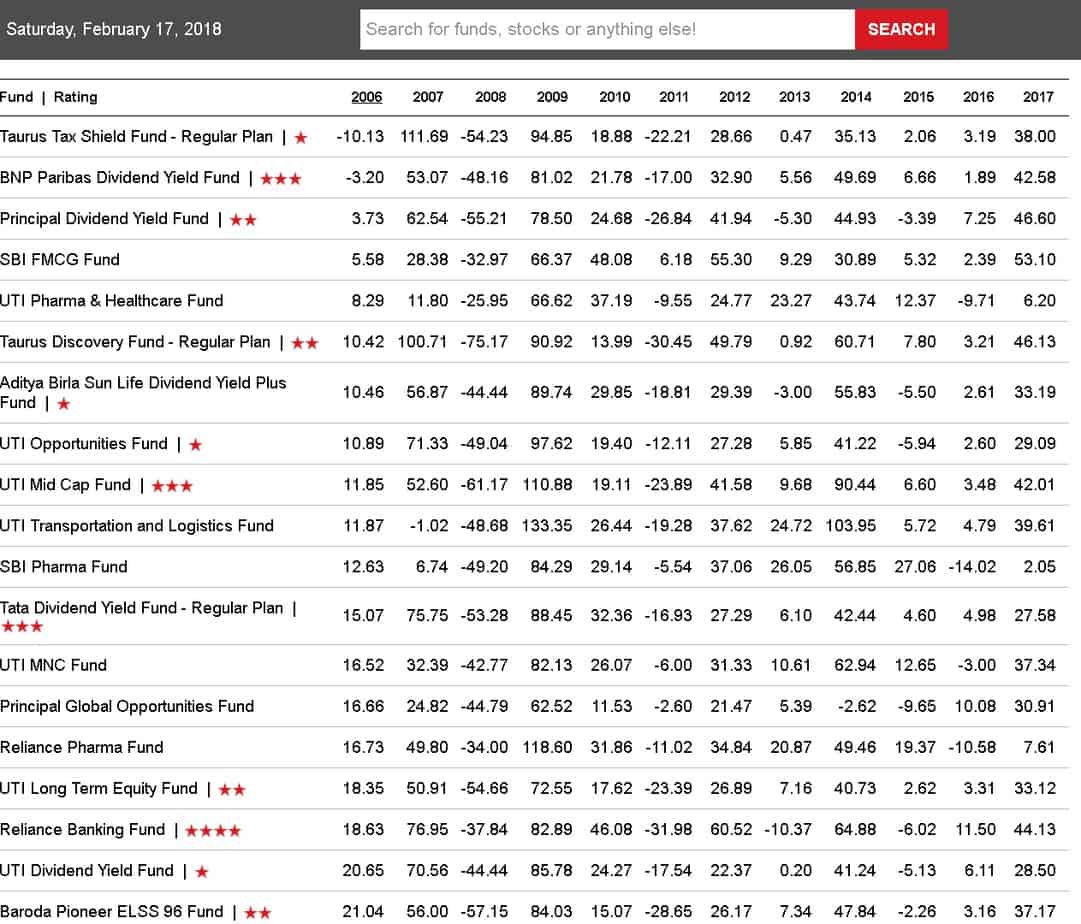
These are annual returns (Jan 1st to Dec 31st). This is how volatile your investment will be. In truth a bit more volatile than this. Never ever assume you will get high returns if you keep investing. That is sales BS.
Start slow, start small, never forgetting the past.
Re-Assemble: money management basics for young earners
Re-assemble is a series focussing on the basics of money management for young earners.
Step 1: Listing your goals dreams and nightmares
Step 2: Lay the Foundations to Get Rich creating an emergency fund
Step 3: How to buy Term Life Insurance
Step 4: How to choose a suitable health insurance policy
* Apollo Munich Optima Restore Benefit vs Max Bupa Re-fill Benefit
* Star Health Comprehensive Insurance vs Religare Care Comprehensive Insurance
* Building a health insurance comparison chart + Cigna TTK vs Royal Sundaram Health Policies
* How to buy a Super Top-up Health Insurance policy
* How I selected a health insurance policy
* Why we all need a corpus for medical expenses and how to build it
Step 5: How to select a credit card for maximum benefit
Step 6: How to track monthly expenses and manage them efficiently
Step 7: How to close your loans and live debt-free
Step 8: How to buy a personal accident insurance policy
Step 9: Are you ready to let go and let your money grow?
Step 10: Investment planning case study 1: How to create an investment plan
Step 11: Case study 2: Retirement planning for 27-year old Amar
Step 12: Three Key Factors that decide how we achieve our financial goals
Step 13: How to start investing in equity? (this post)
Step 14: What should be my first mutual fund?