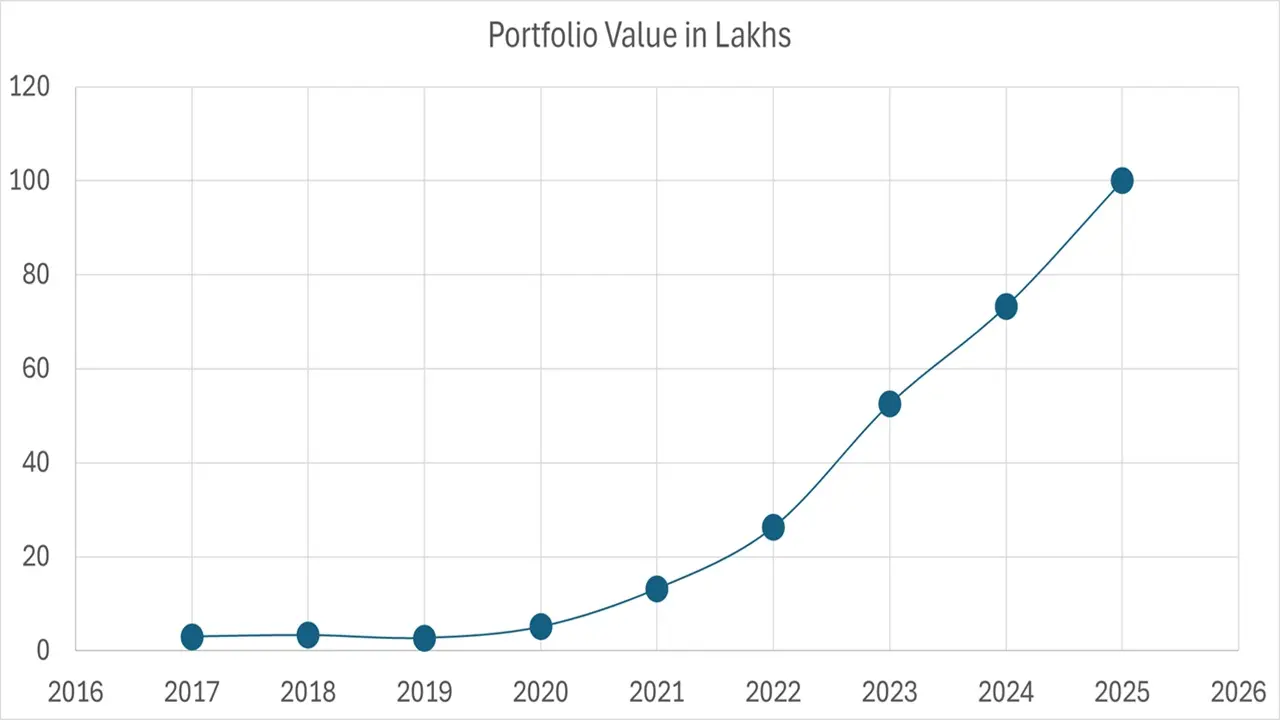
In this edition of the reader story … “This is a chronological account of my investing journey since I started earning in 2017. I am not an expert investor. I have made mistakes, learned along the way, and slowly built discipline. I am sharing this in the hope that it helps early earners who are starting out”.
Opinions expressed in reader stories do not necessarily represent the views of freefincal or its editors. We must appreciate multiple solutions to the money management puzzle and empathise with diverse views. Articles are typically not checked for grammar unless it is necessary to convey the right meaning and preserve the tone and emotions of the writers.
If you would like to contribute to the DIY community in this manner, send your audits to freefincal AT Gmail dot com. You can publish them anonymously if you wish.
Please note: We welcome such articles from young earners who have just started investing. See, for example, this piece by a 29-year-old: How I track financial goals without worrying about returns. We also have a “mutual fund success stories” series. See, for example, how mutual funds helped me achieve financial independence. Now, over to the reader.
Phase A: Finding My Feet (2017–18)
🔥Secure your future with our Robo-advisory tool trusted by over 3,500 investors and advisors. From effortless retirement planning to funding your children’s biggest dreams, turn your financial goals into reality. 🔥
Subscribe for money management solutions via email! (Link takes you to our email sign-up form) Join 32,000+ readers in our community.
👉 New Tool Alert! NaviPlan: A Privacy-Focused Multi-asset Tracker and Goal Planner 👈
I graduated from a Tier-1 MBA college in HR and joined a Big 4 consulting firm in mid-2017 at the age of 24. The initial months were about testing the waters and experimenting with surplus money, which I had plenty of as a bachelor.
My only fixed liability was an education loan EMI of ₹25k per month. I dabbled in stocks, mostly small caps, with a typical holding period of 3-4 months. I also made some lump-sum investments in ELSS funds for tax savings, but hadn’t yet started SIPs.
Phase B: Slow and Steady Beginnings (2018–2020)
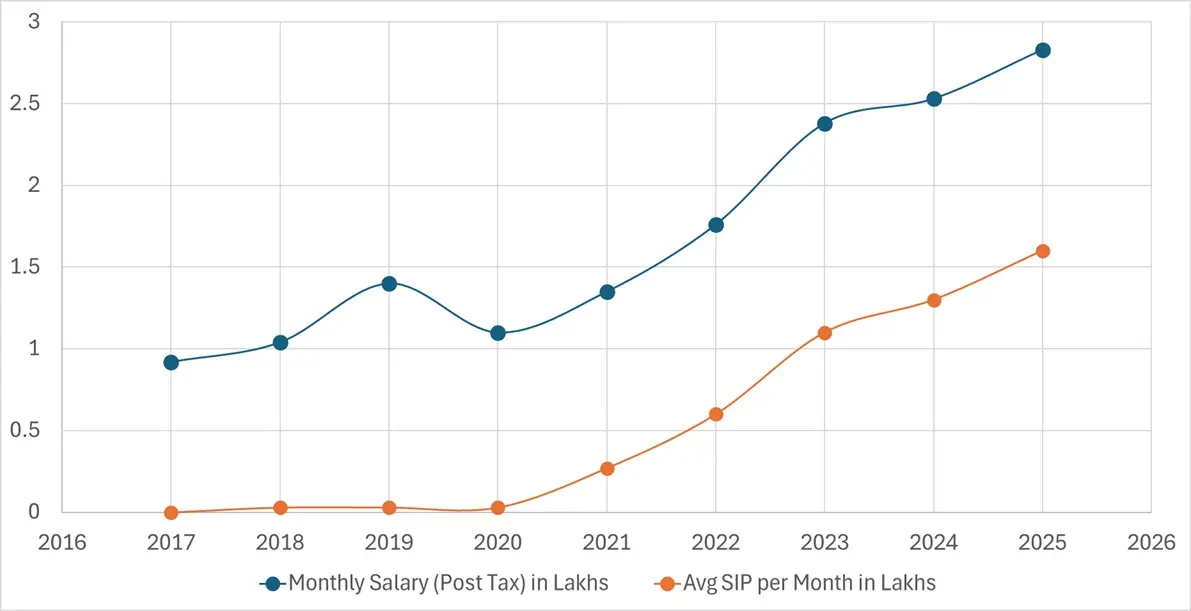
I started my SIP journey in April 2018 with a modest investment of ₹3k per month, split across three equity mutual funds, based on advice from a mutual fund distributor.
The small amount was largely due to a new home loan starting the same month, with an EMI of ₹65k. Combined with my education loan, the total fixed outgo was close to ₹90k per month. However, in hindsight, I realise I could have done better by gradually increasing my SIPs. I stuck to ₹3k per month for almost three years.
Alongside this, I continued investing directly in stocks, mainly for the thrill. I also started reading more about markets and learning basic stock analysis. My holding period slowly increased to 9-12 months during this phase.
Phase C: The Investing Awakening (2020–2023)
Life and investing were on autopilot until COVID struck. Financially, this meant two consecutive years of reduced bonuses and lower take-home pay. With the family’s support, I used this period to fully repay my education loan. I also switched companies during this phase.
The surplus freed up from loan closure was redirected entirely towards SIPs, increasing my monthly investments from ₹3k to ₹27k. Based on my own research, I restructured my mutual fund portfolio into two parts — one managed through my distributor (regular funds) and the other in direct funds.
This phase also marked a shift in my investing mindset. Books like Masterclass with Superinvestors and forums such as Asan Ideas for Wealth and ValuePickr had a lasting impact. My stock analysis deepened, and holding periods for new purchases extended meaningfully.
Well-timed investments during the COVID market drawdown started paying off. For the first time, my stock portfolio turned net green.
Phase D: Compounding with Conviction (2023–Present)
This phase brought major personal and financial milestones. I got married, and I refinanced my home loan at a lower interest rate. This reduced my EMI from ₹65k to ₹42k and significantly increased my monthly surplus.
Inspired by the FIRE movement and reading real-life investment journeys on platforms like FreeFinCal, I aggressively stepped up my SIPs, crossing ₹1 lakh per month. With a long investment horizon, I realised my mutual fund portfolio was heavily skewed towards large caps. I rebalanced it to a 60:20:20 allocation across large-, mid-, and small-cap stocks.
On the stock side, I now invest only after reasonable due diligence, including reading annual reports. My average holding period has increased to 2–3 years. Mutual funds form the core of my wealth-building strategy, while stocks are largely for intellectual engagement. As a result, stocks now constitute about 25% of my portfolio.
Closing Notes
The question of debt funds comes up often. Each time, my answer remains the same — they are not for me at this stage.
As long as my home loan is active, I prefer directing surplus funds to loan repayment rather than to debt products. Additionally, since I don’t foresee redeeming investments in the medium term (5+ years), the risk of an all-equity approach feels acceptable.
That said, a few years down the line, I plan to create a parking fund by gradually shifting part of my equity portfolio into debt or arbitrage funds, with the aim of redeeming it eventually. I also maintain an emergency corpus covering 6–9 months of expenses across savings accounts and FDs.
Reader stories published earlier:
As regular readers may know, we publish a personal financial audit each December – this is the 2024 edition: Portfolio Audit 2024: The Annual Review of My Goal-Based Investments. We asked regular readers to share how they review their investments and track financial goals.
- First audit: How Suhas tracks his MF investments and reviews financial goals.
- Second audit: How Avadhoot Joshi evaluates his investment portfolio.
- Third audit: How a single mom is on track to financial freedom
- Fourth audit: How Gowtham started goal-based investing & took control of his money
- Fifth audit: Why my financial independence & early retirement plans were postponed by four years
- Sixth audit: How Abhisek funded his marriage & is on track to financial freedom.
- Seventh audit: How Rohit’s early struggles defined his investment journey
- Eighth audit: Why my investments are still on track despite job loss and lower income.
- Ninth audit: How a retirement planning calculation scared me to take action
- Tenth audit: I made several investment mistakes but have turned my life around.
- Eleventh audit: My net worth doubled in the last financial year, thanks to patient investing!
- Update: How I achieved investing nirvana.
- Twelfth audit: My financial journey: from novice to goal-based investor.
- Thirteenth audit: My journey: from a negative net worth to goal-based investing.
- Fourteenth audit: From Fixed Deposits to Goal-based investing in MFs.
- Fifteenth audit: My 10-year financial journey – mistakes made and lessons learnt.
- Sixteenth audit (part 1): How I achieved financial independence without mutual funds or stocks.
- Sixteenth audit (part 2): Lessons from my financial independence journey and future investment plans.
- Seventeenth audit: How I plan to achieve financial independence and move to my native place
- Eighteenth audit: I used the current bull run to reduce my mutual funds from 14 to 4!
- Nineteenth audit: How a conservative investor created his financial plan
- Twentieth audit: I plan to achieve financial independence by 46; this is my master plan
- Twenty-first audit: I have made many investment mistakes but am on course to financial independence by 45.
- Twenty-second audit: I felt worthless six years ago but have achieved financial stability today
- Twenty-third audit: My financial journey was directionless until age 40: this is how I made up for lost time
- Twenty-fourth audit: Why I increased equity MF investments by 275% and reduced PPF contributions.
- Twenty-fifth audit: How I track financial goals without worrying about returns
- Twenty-sixth audit: I am 24 and started investing 1Y ago, but what am I investing for?
- Twenty-seventh audit: How we plan to achieve a retirement corpus 50 times our annual expenses.
- Twenty-eighth audit: I thought equity investing was a gamble, but now I aim to hold 60% equity for retirement
- Twenty-ninth audit: My journey: From 5 lakhs in debt to building a corpus worth six years in retirement
- Thirtieth audit: My investment journey: From random purchases to a goal-based portfolio
- Thirty-first audit: My investment journey: from product-driven to process-driven
- Thirty-second audit: How a young couple is trying to balance travelling and investing
- Thirty-third audit: My journey: From Rs. 30 bank balance to financial independence
- Thirty-fourth audit: Our journey: From scratch to a net worth of 18 times annual expenses.
- Thirty-fifth audit: From a net worth of Rs. 6000 to auto-pilot goal-based investing
- Thirty-sixth audit: How I retired from corporate bondage at 46, two years ago!
- Thirty-seventh audit: How I learnt to keep it simple and build a net worth 19 times my annual expenses
- Thirty-eighth audit: How Abhineeth plans to achieve financial independence and build a house.
- Thirty-ninth audit: How Sahil plans to achieve financial independence by efficient tracking
- Fortieth audit: My Journey to a Ten Crore Portfolio
- Forty-first audit: Burdened with debt for several years, I am now aggressively investing in equity
- Forty-second audit: From Engineer to Librarian after Financial Independence and Early Retirement (FIRE)
- Forty-third audit: I lost six months’ income in F&O and ditched it for systematic investing
- Forty-fourth audit: My retirement plan to handle the harsh realities of the IT industry
- Forty-fifth audit: My investment journey: mistakes, 10 years of MF investing and recovery
- Forty-sixth audit: My MF portfolio is worth six crores despite multiple mistakes
- Forty-seventh audit: Saving, Investing, and Running Marathons: My 25-year Journey to Financial Independence
- Forty-eighth audit: Never Too Late to Start: How I Became Financially Savvy at 40
- Forty-ninth audit: My Investment Journey to a net worth 29 times my annual expenses
- Fiftieth audit: How I audit my portfolio without tracking returns
- Fifty-first audit: Financial Lessons Learned During and After a PhD
- Fifty-second audit: Investment & Financial journey of a 23 year old
- Fifty-third audit: The system I use to draw income and spend after retirement securely
- Fifty-fourth audit: From Start-Up Employee to Millionaire: A Success Story of Resilience and Smart Investing
- Fifty-fifth audit: 25-Year-Old Software Engineer’s Investment Journey: From Stocks to Mutual Funds and Beyond
- Fifty-sixth audit: Crossing the Million Mark: Our Journey to the First Crore
- Fifty-seventh audit: Navigating Market Volatility: How an IT Professional Transformed His Investment Approach for Retirement
- Fifty-eighth audit: How Sahil achieved a 10X retirement corpus by efficient portfolio tracking
- Fifty-ninth audit: How I achieved financial freedom by 45 without onsite assignments or ESOPs
- Sixtieth audit: Building Wealth on a Government Salary: Lessons Learned
- Sixty-first audit: Minimalism, Index Funds, and Staying Calm: My Investing Journey at 28
- Sixty-second audit: Building Wealth and Breaking Barriers: How Swati Took Control of Her Financial Future
- Sixty-third audit: My financial journey: How I missed the Compounding Bus!
- Sixty-fourth audit: My MF investment journey: From thematic funds to a 3-fund portfolio
- Sixty-fifth audit: From Debt to ₹1 Crore Liquid Net Worth: My Journey of Financial Awareness.
These published audits have had a compounding effect on readers. If you would like to contribute to the DIY community in this manner, send your audits to freefincal AT Gmail. You can also publish them anonymously.