In this edition of the reader story, we have a personal financial audit in three parts. (1) A reader’s investing journey and how his thinking evolved, (2) a factual audit of his current financial position, and (3) how he is approaching the road ahead.
Opinions expressed in reader stories do not necessarily represent the views of freefincal or its editors. We must appreciate multiple solutions to the money management puzzle and empathise with diverse views. Articles are typically not checked for grammar unless it is necessary to convey the right meaning and preserve the tone and emotions of the writers.
If you would like to contribute to the DIY community in this manner, send your audits to freefincal AT Gmail dot com. You can publish them anonymously if you wish.
Please note: We welcome such articles from young earners who have just started investing. See, for example, this piece by a 29-year-old: How I track financial goals without worrying about returns. We also have a “mutual fund success stories” series. See, for example, how mutual funds helped me achieve financial independence. Now, over to the reader.
My exposure to markets began accidentally around 2010–11, when I was still in my final year of graduation. At that time, my television habits were simple—cartoons and news. One day, while surfing channels, I landed on a business news channel airing a stock market show.
Join 32,000+ readers and get free money management solutions delivered to your inbox! Subscribe to get posts via email! (Link takes you to our email sign-up form)

🔥Want to create a complete financial plan? Learn goal-based investing? Exclusive access to our DIY tools? Increase your income with your skills? Use this link to enjoy massive discounts on our robo-advisory tool & courses! 🔥
There was an anchor, a guest introduced as a market expert, and callers seeking advice. The expert was confidently telling callers which stocks to buy, which to sell, and which to hold. He spoke with certainty and authority. I was in awe. I remember thinking, people are being told exactly how to make money.
I started watching that show regularly. It became my favourite program on television. I genuinely believed that these experts knew what they were doing and that, someday, I too could benefit from this “knowledge”.
My family, especially my mother, was uncomfortable with this. She would tell me not to watch this “satta bazaar”—a gambling den, as she saw it. According to her, the stock market was not meant for people like us. I brushed this off. I thought she simply didn’t understand modern investing.
Then one day, something happened that stayed with me.
A caller asked for advice on a stock that was in loss. The expert calmly suggested selling it. The caller responded angrily: “It was you who told me to buy this stock on this very show. Now that it is not performing, you are telling me to sell?” The expert replied that the stock could still do well if held for one or two years.
That exchange hit me hard.
Until then, I had believed that experts had clarity, if not certainty. That moment made me realise that advice could change, narratives could shift, and accountability was missing. At that very moment, I told myself something quite extreme: I will never buy a stock directly. To this day, I do not have a demat account.
Soon after, I discovered similar shows focused on mutual funds. The format was identical—anchor, expert, callers—but mutual funds felt safer, more respectable, and more suitable for someone like me. These shows talked endlessly about returns, and that became the only thing that stuck with me. Mutual funds, I believed, were a smarter, more mature version of stock investing.
I graduated in 2012 and started working in 2013. I wanted to invest in mutual funds, but I had no idea how. In 2014, a friend told me to bring a blank cheque and copies of my PAN and Aadhaar. He took me to a person who, he said, would “do everything”.
I asked a basic question: Which mutual fund should I invest in?
The answer was simple: a small-cap fund and an infrastructure fund—because they were giving good returns.
That was enough for me.
Over the next five years, I experienced my first real investing emotions. The small-cap fund would rise sharply, then fall just as sharply. When it went up, I felt smart. When it went down, I felt anxious. The infrastructure fund barely moved and delivered low, single-digit returns. I didn’t understand why. I didn’t know why one fund was volatile, and another was stagnant. Still, I felt some satisfaction that I was at least “investing”.
As my income increased, I added more funds—an ELSS fund and a mid-cap fund in 2018—again based on expert recommendations from television and YouTube. Almost immediately after starting these SIPs, returns began to fall.
Watching NAVs go down day after day was deeply unsettling. I didn’t know what was wrong. I didn’t know whether this was normal. I kept telling myself to be patient, but inside I was frustrated and confused.
What angered me the most was seeing the same experts who had recommended these funds later advising others on television to sell them. When callers confronted them—just as that stock investor had years earlier—the answers were vague: you can sell, you can hold, you can switch. None of it helped me decide what I should do. Meanwhile, expenses were being charged regardless of performance.
That frustration pushed me to learn on my own. I discovered TERs, the distinction between regular and direct plans, and the role of mutual fund distributors. I realised that all my investments were in regular plans and that I was paying higher costs without receiving any real guidance. I felt cheated—more by my own ignorance than by anyone else.
I stopped investing through distributors and started SIPs directly in two large-cap funds and one multi-cap fund. I felt relieved—finally, I was “doing it myself”.
But this only added to the confusion. I now have seven funds across categories: small-cap, infrastructure, ELSS, mid-cap, large-cap, and multi-cap. Despite investing for years, my emotions were still tied to short-term returns. A few months of negative performance would bother me disproportionately. I still had no real understanding of asset allocation or long-term risk.
Index funds were mentioned occasionally, but almost always dismissed as inferior—something for beginners or people willing to settle for lower returns. I absorbed that messaging and stayed away from them.
Everything came to a head in 2020.
During the COVID crash, my entire portfolio turned red. At the same time, I started hearing about diversification formulas like 60–30–10 (flexi/large–mid–small). For the first time, diversification felt like a rule rather than a hope. This structure gave me comfort. I convinced myself that if I just selected the best-performing active funds in each category and maintained this ratio, I would be safe.
I even decided that, starting in 2021, I would clean up my portfolio and implement this plan. I genuinely felt I had finally figured things out.
Around this time, I heard Subra say something that made me uncomfortable. He remarked that when he appears on television, people ask what to do about equity investments that have given negative returns over the last six months. His response was blunt: equities are meant for decades, not months.
I realised with some embarrassment that I was exactly that person.
I was calling myself a long-term investor, but emotionally reacting to every fall. That contradiction forced me to stop and reflect. For the first time, I started thinking seriously about retirement and long-term goals, rather than just returns and recoveries.
Soon after, I read a personal finance audit by Avadhoot Joshi on Freefincal, which led me to the Asan Ideas for Wealth (AIFW) community.
This changed everything.
The conversations there were not about beating the index or finding the next top fund. They were about goals, asset allocation, risk, and—most importantly—behaviour. I realised that most of my stress over the years had come not from low returns, but from not having a framework I could emotionally live with.
Index funds, which I had once dismissed, now made sense. Not because they promised higher returns, but because they reduced decision-making, regret, and self-doubt. They allowed me to stay invested without constantly questioning myself.
My choice to stick with index funds is not ideological. It is personal. I know myself well enough to admit that I cannot consistently pick winning active funds or stick with them through long periods of underperformance. I have lived that cycle already.
My goal is simple: reach a defined financial target in a given time frame with as little emotional turmoil as possible. Index funds help me do that. Others may choose active funds, and that is perfectly fine.
This journey taught me one uncomfortable but liberating lesson: I alone am responsible for my financial outcomes. Index funds are the tool I have chosen, fully aware of their limitations. I have chosen this path deliberately, and I do not intend to return to active funds.
PART 2: The Exact Personal Finance Audit
Are the Basics Covered?
One of the first questions repeatedly asked in the Asan Ideas for Wealth (AIFW) group by Ashal Jauhari is:
“Are the basics covered?”
Before discussing asset allocation, mutual funds, or returns, this question forces a check on financial survivability. Over time, I have realised that without these basics in place, any discussion about investing remains fragile. Using this framework, I am listing my current financial position below, without attempting to optimise or defend any decisions.
- Term Insurance
- Current cover: ₹2 crore term insurance from Max Life
(Initially ₹1 crore; increased by an additional ₹1 crore as income grew) - Income multiple covered: Roughly in line with the commonly suggested basic range of 15–20× annual income
- Concerns/gaps:
While the cover broadly meets the basic guideline, it may still need reassessment over time, considering inflation, remaining working years, and future responsibilities.
- Health Insurance
- Personal health insurance:
- ₹10 lakh base policy + ₹90 lakh super top-up with Tata AIG
- Policy taken through Neeraj K (AIFW reference)
- Employer health insurance: ₹6 lakh
- Known exclusions or worries: None identified as of now
This setup provides high coverage independent of employment and does not rely solely on the employer policy.
- Emergency Fund
- Average monthly expenses: Equivalent of ~3 months
- Emergency corpus available: Yes
- Months of expenses covered: ~3 months
- Parking of funds:
- SBI MOD account
- Arbitrage fund
- A small SIP in a liquid fund started a few years ago to partially address the loss of purchasing power
The current emergency fund provides short-term comfort but does not yet meet the more conservative 12-months-of-expenses guideline.
- Goals Identified
- Retirement:
- Target age: 60
- Years away: ~25 years
- Other major goals: None identified at this stage
At present, retirement is the only clearly defined long-term financial goal.
Assets, Asset Allocation, and Current Position
(December 2025 snapshot)
For consistency and long-term tracking, the retirement corpus is defined upfront as X, and progress is measured relative to this target.
- Current progress: ~5.3% of the targeted retirement corpus (X)
Absolute numbers are intentionally avoided to keep the focus on structure and progress rather than scale.
Progress toward the targeted retirement corpus (X)
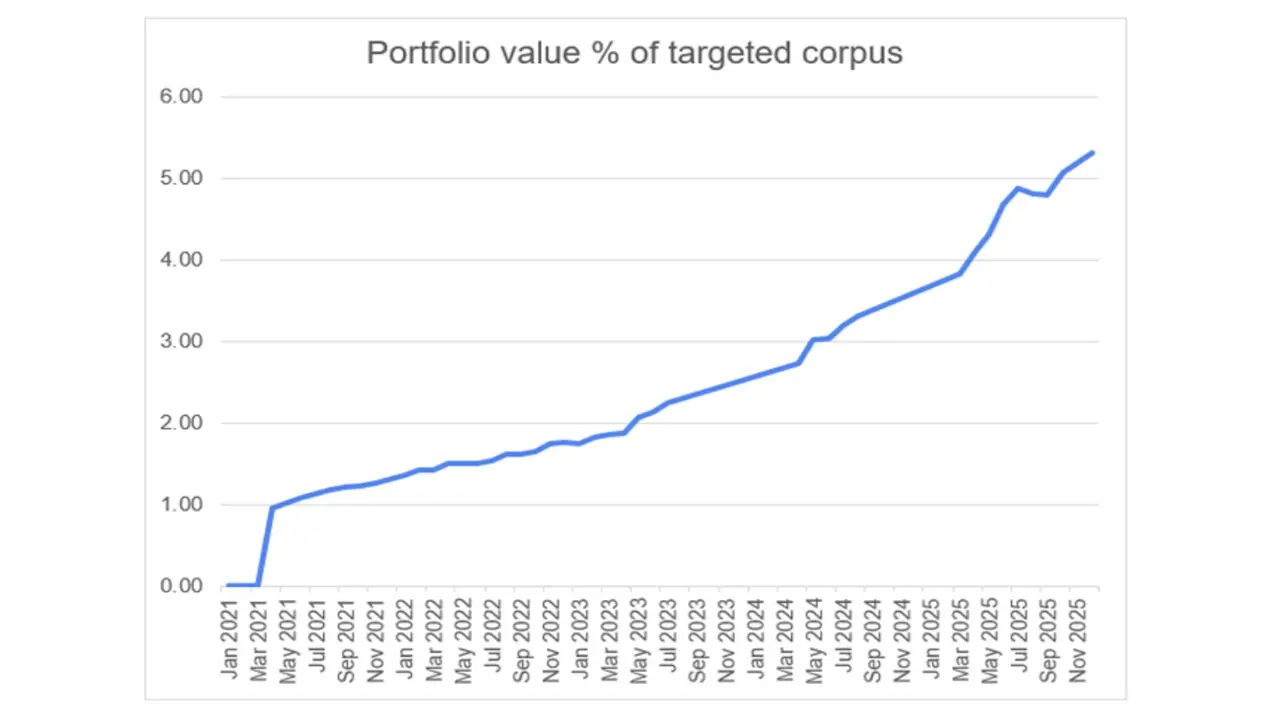
This chart tracks progress relative to the defined retirement goal and is used only as a directional indicator, not as a measure of short-term performance.
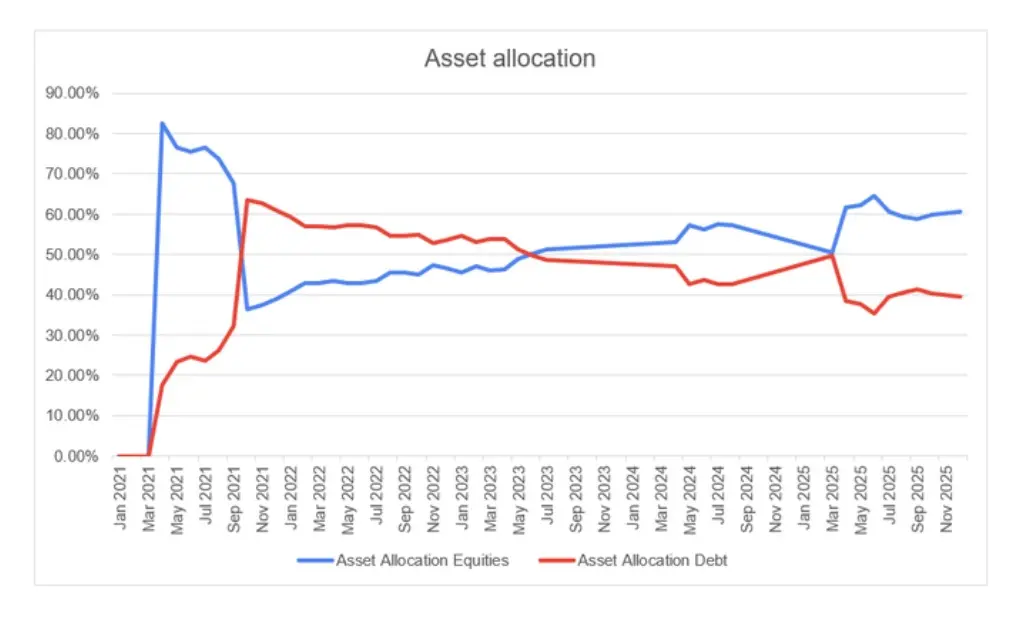
Overall Asset Allocation (%)
- Equity: 60.48%
- Debt / Stability: 39.52%
Equity Allocation (% of Equity)
- Nifty 50 Index Fund: 88.84%
- Other Equity Mutual Funds: 4.70%
- NPS (Equity component): 6.46%
The equity portion is intentionally concentrated around a broad-market index.
The allocation to other equity mutual funds represents legacy investments from an earlier phase of my investing journey. Most of this exposure has already been withdrawn over time, with proceeds either reinvested or redeployed elsewhere. Going forward, this allocation is expected to reduce to zero, as no fresh investments are planned in active equity funds.
Debt / Stability Allocation (% of Debt)
- EPF: 50.39%
- PPF: 11.79%
- NPS (Debt component): 37.18%
- Gold (SGB): 0.63%
Debt allocation is dominated by long-term, retirement-oriented instruments, resulting in relatively low liquidity but high predictability.
Context on EPF, PPF, and NPS Contributions
The presence of EPF, PPF, and NPS in the portfolio is largely the result of earlier tax-driven decisions, made before I was introduced to AIFW-style goal-based planning.
- PPF and NPS were initially started primarily for tax savings under the old tax regime.
- With the transition to the new tax regime, I was effectively locked into these instruments.
- Subsequently, my individual NPS was converted into a corporate NPS, and all superannuation benefits were transferred to this account.
- As a result, my employer now contributes to both EPF and NPS on an ongoing basis.
- PPF contributions are currently kept at a minimum level, primarily to keep the account active rather than as a core accumulation vehicle.
This explains why a significant portion of the debt allocation is concentrated in EPF and NPS, even though fresh voluntary contributions are limited.
Portfolio Allocation (% of Total Portfolio)
- Nifty 50 Index Fund: 53.73%
- Other Equity Mutual Funds: 2.84%
- EPF: 19.91%
- PPF: 4.66%
- NPS (Equity + Debt combined): 18.60%
- Gold (SGB): 0.25%
NPS is primarily used as a structural tool to correct asset allocation whenever the intended equity–debt balance (60:40) gets disturbed. This approach is based on an idea I came across in a tweet by Swapnil Kendhe, where NPS contributions are used flexibly to tilt the portfolio back toward the desired allocation rather than as a return-maximising instrument.
Liabilities
- Home loan: No
- Other loans: No
There are currently no outstanding liabilities.
Changes During the Last Year
During the last year, there has been no major structural change in the portfolio.
Equity exposure has increased gradually and organically, primarily through ongoing investments rather than deliberate rebalancing or tactical decisions. The overall asset allocation framework and investment choices have remained unchanged.
This stability reflects a conscious decision to prioritise consistency over frequent adjustments.
Closing Note
This audit captures my financial position as of December 2025. The portfolio is intentionally simple, largely index-driven on the equity side, and anchored by long-term retirement instruments on the debt side. While certain gaps remain—most notably the size of the emergency fund—they are known and acknowledged.
At this stage, the focus is on behaviour, consistency, and survivability, not optimisation.
PART 3: The Road Ahead
How I Think About the Next Phase
This final section is not about predictions or guarantees. It reflects how my thinking continues to evolve, based on what I have already experienced and what I am comfortable living with over the long term.
- Emergency Fund: Comfort as a Lump Sum, Not a Formula
I do not think about my emergency fund in terms of “months of salary” or “months of expenses”. Instead, I am more comfortable defining it as a lump-sum buffer that provides both practical and psychological comfort.
Rather than chasing a formula-driven target, my approach is to build a standalone emergency corpus that feels sufficient for unexpected situations. To support this, I have started a SIP in a liquid fund earmarked specifically for this purpose and to mitigate the loss of purchasing power, as discussed earlier.
This allows the emergency buffer to build gradually and independently, without forcing abrupt changes or drawing from long-term investments.
- Index Funds: A Conscious and Final Choice
My preference for index funds is a deliberate and settled choice, shaped by experience rather than comparison. I do not intend to return to actively managed mutual funds.
Index funds allow me to remain invested without constant evaluation, fund switching, or second-guessing. Going forward, my equity investments will increasingly move toward broader market indices, such as:
- Nifty 100
- Nifty 500
- or a Nifty Total Market index
The intent is to own the market more broadly rather than concentrating only on the largest stocks. As my portfolio reaches a certain size (X), I plan to stop incremental investments in the Nifty 50 and direct new equity contributions toward a broader representation of the Indian equity market.
This transition will be gradual and driven by portfolio scale, not market conditions.
- International Equity
At present, international mutual fund investments are constrained due to regulatory limits. Once these limits are lifted, I would like to explore allocating a portion of my equity exposure to international markets.
I have deliberately not fixed a percentage for this allocation. The decision will be taken when the option becomes practically available, based on simplicity of execution and overall portfolio context at that time.
- Asset Allocation and Rebalancing: Flexibility in Tools
Currently, asset allocation corrections are largely handled through NPS contributions, and this works for me today.
However, I recognise that this option may not always remain available or flexible. If that happens, I am comfortable using arbitrage funds as an alternative tool for rebalancing between equity and debt, rather than disturbing long-term holdings or reacting to short-term movements.
While the tools used for rebalancing may change, the intent remains the same:
Maintain the chosen asset allocation with minimal complexity and intervention.
- On Uneven Contributions and Life Events
Until a few years ago, my contributions were largely regular. During a phase of significant personal change, however, contributions became uneven and, at times, paused altogether.
Rather than viewing this as a failure of discipline, I now see it as an important lesson: long-term investing has to coexist with life events, not compete with them. During this period, the focus shifted from maximising contributions to simply preserving the existing structure and avoiding reactive decisions.
This experience reinforced my belief that a sustainable financial system is one that can absorb interruptions without breaking.
Closing Thoughts
Over time, my focus has shifted away from chasing returns or tracking XIRR. I honestly do not remember when I last checked them.
What matters to me now is steady progress toward a clearly defined target (X). As long as I am moving in that direction, I am comfortable letting the process play out without constant measurement or comparison.
This audit reflects where I stand today, with the understanding that future decisions will be guided by clarity, simplicity, and consistency rather than performance noise.
Reader stories published earlier:
As regular readers may know, we publish a personal financial audit each December – this is the 2024 edition: Portfolio Audit 2024: The Annual Review of My Goal-Based Investments. We asked regular readers to share how they review their investments and track financial goals.
- First audit: How Suhas tracks his MF investments and reviews financial goals.
- Second audit: How Avadhoot Joshi evaluates his investment portfolio.
- Third audit: How a single mom is on track to financial freedom
- Fourth audit: How Gowtham started goal-based investing & took control of his money
- Fifth audit: Why my financial independence & early retirement plans were postponed by four years
- Sixth audit: How Abhisek funded his marriage & is on track to financial freedom.
- Seventh audit: How Rohit’s early struggles defined his investment journey
- Eighth audit: Why my investments are still on track despite job loss and lower income.
- Ninth audit: How a retirement planning calculation scared me to take action
- Tenth audit: I made several investment mistakes but have turned my life around.
- Eleventh audit: My net worth doubled in the last financial year, thanks to patient investing!
- Update: How I achieved investing nirvana.
- Twelfth audit: My financial journey: from novice to goal-based investor.
- Thirteenth audit: My journey: from a negative net worth to goal-based investing.
- Fourteenth audit: From Fixed Deposits to Goal-based investing in MFs.
- Fifteenth audit: My 10-year financial journey – mistakes made and lessons learnt.
- Sixteenth audit (part 1): How I achieved financial independence without mutual funds or stocks.
- Sixteenth audit (part 2): Lessons from my financial independence journey and future investment plans.
- Seventeenth audit: How I plan to achieve financial independence and move to my native place
- Eighteenth audit: I used the current bull run to reduce my mutual funds from 14 to 4!
- Nineteenth audit: How a conservative investor created his financial plan
- Twentieth audit: I plan to achieve financial independence by 46; this is my master plan
- Twenty-first audit: I have made many investment mistakes but am on course to financial independence by 45.
- Twenty-second audit: I felt worthless six years ago but have achieved financial stability today
- Twenty-third audit: My financial journey was directionless until age 40: this is how I made up for lost time
- Twenty-fourth audit: Why I increased equity MF investments by 275% and reduced PPF contributions.
- Twenty-fifth audit: How I track financial goals without worrying about returns
- Twenty-sixth audit: I am 24 and started investing 1Y ago, but what am I investing for?
- Twenty-seventh audit: How we plan to achieve a retirement corpus 50 times our annual expenses.
- Twenty-eighth audit: I thought equity investing was a gamble, but now I aim to hold 60% equity for retirement
- Twenty-ninth audit: My journey: From 5 lakhs in debt to building a corpus worth six years in retirement
- Thirtieth audit: My investment journey: From random purchases to a goal-based portfolio
- Thirty-first audit: My investment journey: from product-driven to process-driven
- Thirty-second audit: How a young couple is trying to balance travelling and investing
- Thirty-third audit: My journey: From Rs. 30 bank balance to financial independence
- Thirty-fourth audit: Our journey: From scratch to a net worth of 18 times annual expenses.
- Thirty-fifth audit: From a net worth of Rs. 6000 to auto-pilot goal-based investing
- Thirty-sixth audit: How I retired from corporate bondage at 46, two years ago!
- Thirty-seventh audit: How I learnt to keep it simple and build a net worth 19 times my annual expenses
- Thirty-eighth audit: How Abhineeth plans to achieve financial independence and build a house.
- Thirty-ninth audit: How Sahil plans to achieve financial independence by efficient tracking
- Fortieth audit: My Journey to a Ten Crore Portfolio
- Forty-first audit: Burdened with debt for several years, I am now aggressively investing in equity
- Forty-second audit: From Engineer to Librarian after Financial Independence and Early Retirement (FIRE)
- Forty-third audit: I lost six months’ income in F&O and ditched it for systematic investing
- Forty-fourth audit: My retirement plan to handle the harsh realities of the IT industry
- Forty-fifth audit: My investment journey: mistakes, 10 years of MF investing and recovery
- Forty-sixth audit: My MF portfolio is worth six crores despite multiple mistakes
- Forty-seventh audit: Saving, Investing, and Running Marathons: My 25-year Journey to Financial Independence
- Forty-eighth audit: Never Too Late to Start: How I Became Financially Savvy at 40
- Forty-ninth audit: My Investment Journey to a net worth 29 times my annual expenses
- Fiftieth audit: How I audit my portfolio without tracking returns
- Fifty-first audit: Financial Lessons Learned During and After a PhD
- Fifty-second audit: Investment & Financial journey of a 23-year-old
- Fifty-third audit: The system I use to draw income and spend after retirement securely
- Fifty-fourth audit: From Start-Up Employee to Millionaire: A Success Story of Resilience and Smart Investing
- Fifty-fifth audit: 25-Year-Old Software Engineer’s Investment Journey: From Stocks to Mutual Funds and Beyond
- Fifty-sixth audit: Crossing the Million Mark: Our Journey to the First Crore
- Fifty-seventh audit: Navigating Market Volatility: How an IT Professional Transformed His Investment Approach for Retirement
- Fifty-eighth audit: How Sahil achieved a 10X retirement corpus by efficient portfolio tracking
- Fifty-ninth audit: How I achieved financial freedom by 45 without onsite assignments or ESOPs
- Sixtieth audit: Building Wealth on a Government Salary: Lessons Learned
- Sixty-first audit: Minimalism, Index Funds, and Staying Calm: My Investing Journey at 28
- Sixty-second audit: Building Wealth and Breaking Barriers: How Swati Took Control of Her Financial Future
- Sixty-third audit: My financial journey: How I missed the Compounding Bus!
- Sixty-fourth audit: My MF investment journey: From thematic funds to a 3-fund portfolio
- Sixty-fifth audit: From Debt to ₹1 Crore Liquid Net Worth: My Journey of Financial Awareness.
These published audits have had a compounding effect on readers. If you would like to contribute to the DIY community in this manner, send your audits to freefincal AT Gmail. You can also publish them anonymously.

Use our Robo-advisory Tool to create a complete financial plan! ⇐More than 3,000 investors and advisors use this! Use the discount code: robo25 for a 20% discount. Plan your retirement (early, normal, before, and after), as well as non-recurring financial goals (such as child education) and recurring financial goals (like holidays and appliance purchases). The tool would help anyone aged 18 to 80 plan for their retirement, as well as six other non-recurring financial goals and four recurring financial goals, with a detailed cash flow summary.
🔥You can also avail massive discounts on our courses and the freefincal investor circle! 🔥& join our community of 8000+ users!
Track your mutual funds and stock investments with this Google Sheet!
We also publish monthly equity mutual funds, debt and hybrid mutual funds, index funds, and ETF screeners, as well as momentum and low-volatility stock screeners.
You can follow our articles on Google News

We have over 1,000 videos on YouTube!

Join our WhatsApp Channel
- Do you have a comment about the above article? Reach out to us on Twitter: @freefincal or @pattufreefincal
- Have a question? Subscribe to our newsletter using the form below.
- Hit 'reply' to any email from us! We do not offer personalised investment advice. We can write a detailed article without mentioning your name if you have a generic question.
Join 32,000+ readers and get free money management solutions delivered to your inbox! Subscribe to get posts via email! (Link takes you to our email sign-up form)
About The Author
 Dr M. Pattabiraman (PhD) is the founder, managing editor and primary author of freefincal. He is an associate professor at the Indian Institute of Technology, Madras. He has over 13 years of experience publishing news analysis, research and financial product development. Connect with him via Twitter(X), LinkedIn, or YouTube. Pattabiraman has co-authored three print books: (1) You can be rich too with goal-based investing (CNBC TV18) for DIY investors. (2) Gamechanger for young earners. (3) Chinchu Gets a Superpower! for kids. He has also written seven other free e-books on various money management topics. He is a patron and co-founder of “Fee-only India,” an organisation promoting unbiased, commission-free, AUM-independent investment advice.
Our flagship course! Learn to manage your portfolio like a pro to achieve your goals regardless of market conditions! ⇐ More than 3,500 investors and advisors are part of our exclusive community! Get clarity on how to plan for your goals and achieve the necessary corpus no matter the market condition!! Watch the first lecture for free! One-time payment! No recurring fees! Life-long access to videos! Reduce fear, uncertainty and doubt while investing! Learn how to plan for your goals before and after retirement with confidence.
Increase your income by getting people to pay for your skills! ⇐ More than 800 salaried employees, entrepreneurs and financial advisors are part of our exclusive community! Learn how to get people to pay for your skills! Whether you are a professional or small business owner seeking more clients through online visibility, or a salaried individual looking for a side income or passive income, we will show you how to achieve this by showcasing your skills and building a community that trusts and pays you. (watch 1st lecture for free). One-time payment! No recurring fees! Life-long access to videos!
Our book for kids: “Chinchu Gets a Superpower!” is now available!


Must-read book even for adults! This is something that every parent should teach their kids right from their young age. The importance of money management and decision making based on their wants and needs. Very nicely written in simple terms. - Arun.Buy the book: Chinchu gets a superpower for your child!
How to profit from content writing: Our new ebook is for those interested in getting a side income via content writing. It is available at a 50% discount for Rs. 500 only!
Do you want to check if the market is overvalued or undervalued? Use our market valuation tool (it will work with any index!), or get the Tactical Buy/Sell timing tool!
We publish monthly mutual fund screeners and momentum, low-volatility stock screeners.
About freefincal & its content policy. Freefincal is a News Media organisation dedicated to providing original analysis, reports, reviews and insights on mutual funds, stocks, investing, retirement and personal finance developments. We do so without conflict of interest and bias. Follow us on Google News. Freefincal serves more than three million readers a year (5 million page views) with articles based only on factual information and detailed analysis by its authors. All statements made will be verified with credible and knowledgeable sources before publication. Freefincal does not publish paid articles, promotions, PR, satire or opinions without data. All opinions will be inferences backed by verifiable, reproducible evidence/data. Contact Information: To get in touch, please use our contact form. (Sponsored posts or paid collaborations will not be entertained.)
Connect with us on social media
- Twitter @freefincal
- Subscribe to our YouTube Videos
- Posts feed via Feedburner.
Our publications
You Can Be Rich Too with Goal-Based Investing
 Published by CNBC TV18, this book is designed to help you ask the right questions and find the correct answers. Additionally, it comes with nine online calculators, allowing you to create custom solutions tailored to your lifestyle. Get it now.
Gamechanger: Forget Startups, Join Corporate & Still Live the Rich Life You Want
 This book is designed for young earners to get their basics right from the start! It will also help you travel to exotic places at a low cost! Get it or gift it to a young earner.
Your Ultimate Guide to Travel
 This is an in-depth exploration of vacation planning, including finding affordable flights, budget accommodations, and practical travel tips. It also examines the benefits of travelling slowly, both financially and psychologically, with links to relevant web pages and guidance at every step. Get the PDF for Rs 300 (instant download)